Two months off of the countrywide tour for I Hate My Job, I’m still overwhelmed by gratitude. I’m awash, if you will, in the glow of seeing sex workers, and workers broadly, across the nation united under the banner of “sex work is work and work is really quite terrible.” There’s a special kind of solidarity that comes from being in rooms full of strangers, who find common cause with you, regardless of gender, race, ethnicity, religion, or what space we occupy in the sex industry. Along with that sense of camaraderie, there’s a shared suffering. Quiet, rarely acknowledged for its mundane regularity, but no less devastating when it catches you out. Being a sex worker means trading the most boring parts of everyday life for a neverending game of what if.
There are so many things I can’t just do as a sex worker. Oh sure, a plethora of rights and privileges are available to me. I can vote, pay taxes, drive a car, get a passport (at least in theory), and I can probably walk to the bottom of the hill and buy a gas station sandwich without anyone asking invasive questions. I can easily go to Aldi, or Walmart, or Giant Eagle and buy an obscene amount of cheese without being subjected to a background check. I might even dance around my home in my underwear, without anyone calling the police. But I cannot, with any reasonable guarantee of stability, participate in the modern economy.
Being a sex worker means trading the most boring parts of everyday life for a neverending game of what if.
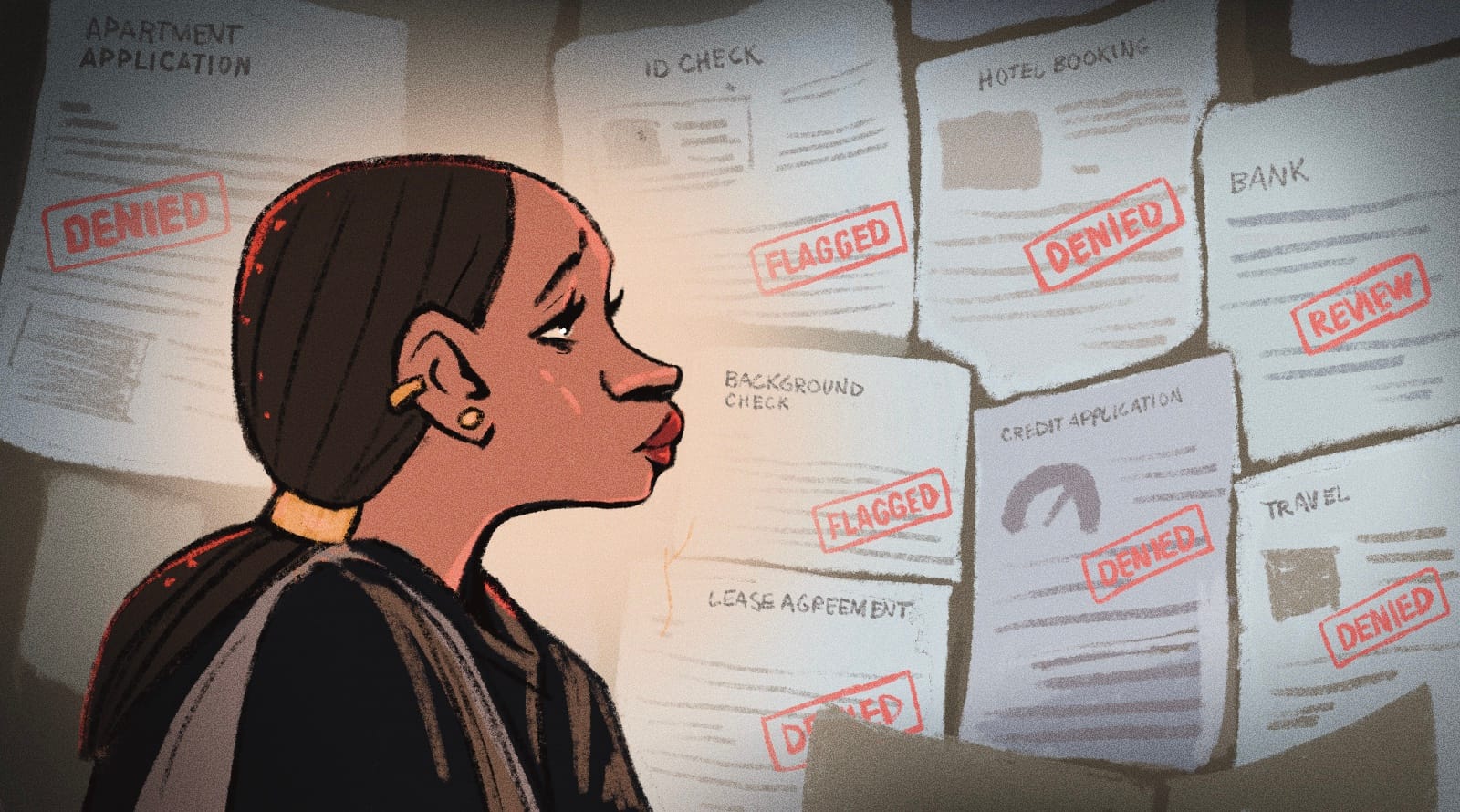
Top of mind, for tour-related reasons, is that I can’t just… get a room somewhere. I can’t book a vacation rental without employing a stygian web of VPNs, and private browsers, and burner devices to work within an indecipherable algorithm that has unilaterally decided I am an “undesirable” sort who engages in antisocial behaviours. Through a long history of “respectable” work which requires booking large hotel blocks for others, I have established enough of a facade of normalcy to book a single hotel room with one large chain. But when this chain is unavailable to me, as it would be in a small town or foreign locale, I’m forced to play a shadow game. Do I book the hotel room and hope that a well-meaning, if poorly trained, hotel employee doesn’t see my single self and requests for extra towels as evidence of a life of crime and debauchery? Do I create yet another profile on an app that purports to bring all the comforts of home to a stranger’s spare room, hoping against hope that all my tricks will prevent my browser activity from being scraped for assignment of a social good score?
I can’t keep a bank account either. I tell myself that it’s fine, because credit unions are better, and they are, but it’s the principle of the thing. Why should large banks care how I make my money, so long as I make regular deposits and pay my taxes? Why should politicians who know nothing about me or my life choices get to legislate away my ability to create a paper trail in the hopes of buying a home, or car, or renting an apartment, while telling me it’s for my own good?
If I allow myself a bit of speculative post SESTA/FOSTA fancy, playing round robin with financial institutions seems like an easy enough, if tedious compromise, until you run out of “legitimate” banks and are left with a thinning field of increasingly dubious fintech startups and “financial products” without Federal Deposit Insurance Corporation (FDIC) insurance. Now hundreds, if not thousands, of your dollars are missing, lost to the digital ether with no legal recourse for getting them back. The consequences compound faster than the industry-standard half-a-percent interest: no bank account, no credit, no housing, no car.
Why should politicians who know nothing about me,
get to legislate away my ability to create a paper trail?
I can’t share an apartment or a ride with another sex worker. In this post-SESTA/FOSTA world, that’s a felony and we’re both guilty of profiting from the exploitation of the other. That’s if the landlord doesn’t evict us both for running a commercial enterprise in a residential property. I can’t buy a ticket to the Super Bowl, or even travel to the same city as the Super Bowl, because I could be detained at the airport. My internet history, you see, may have flagged me as a threat in some secretive, federal database which is only triggered when the Transport Security Administration asks me to remove my mask and scan my face in the PreCheck line. I can’t order a meal through DoorDash because Visa or Mastercard sold my consumer data and transaction history, including my payouts from various clients, dungeons, OnlyFans, or adjacent sites.
Was I implicated in a plot to overthrow some small country or pull off an Ocean’s-inspired heist? Surely, this kind of all-encompassing, persistent socioeconomic death is punishment for a crime so egregious that it defies modern understanding? But no, the crime is being perceived as so desirable that I become undesirable. In a country so obsessed with the pretense of rehabilitation, selling sex is so unforgivable as to require the complete eradication of your identity and public existence. The omnipresent, omniscient “they” would rather you disappear entirely from notice than play at your eventual return to grace. This is completely antithetical to the American conception of crime wherein you are found guilty, sentenced, and deemed socially redeemed after an appropriate amount of time. This is one theory, anyway.
Surely, this kind of all-encompassing, persistent socioeconomic death is punishment for a crime so egregious that it defies modern understanding?
Sex work occupies a liminal space of criminality, where much of it is not functionally a crime, but it feels like it should be. It should be a crime to be desired by men who imagine themselves above the vulgar banality of sexual urges. It should be a crime to acknowledge your attractiveness in a world that punishes Black, brown, fat, disabled, and queer bodies for existing, rather than hiding it away in shapeless, formless nothingness and anonymity. It should be a crime to internalise the mantra of “Fuck you, Pay me,” in a late-stage capitalist hell which has deemed you, before birth, to be a have-not, 99-percent plebian. Where the system cannot legally punish you for crimes you haven’t committed, it seeks to socially excise you instead. When you cannot be literally interned, in a sham of rehabilitation, you are functionally erased from notice and removed from the social experience instead.
I would like to be a person who escapes notice, but is still acknowledged as a person. I would like to be wholly uninteresting to those who imagine themselves above me, the arbiters of morality, and the makers of the rules. I would like to be a person who can casually book a hotel room or vacation rental, make deposits and withdrawals without worrying if I’m incurring the wrath of the IRS, and take my bank statements to a landlord or car dealer without a second thought. I would like to be a productive member of society who doesn’t make waves or draw attention. I would like the extraordinary privilege of being presumed innocent in the most routine circumstances of my everyday life. In short, I would like to be boring.
A Note to Our Community: The Tryst.link blog is not affiliated with or endorsing any sites, brands, or products linked here. We share resources only where we feel they might add real value to sex workers’ knowledge or autonomy—and when the benefit feels worth the risk.
For more articles on sex work and discrimination, check out The Challenge of Community Care for Criminalized Workers, Sex Work Online: Linguistics and Censorship, and The Endless Closet: A Narnia of Marginalised Identities.
Are you a sex worker with a story, opinion, news, or tips to share? We'd love to hear from you!
We started the tryst.link sex worker blog to help amplify those who aren't handed the mic and bring attention to the issues ya'll care about the most. Got a tale to tell? 👇☂️✨