
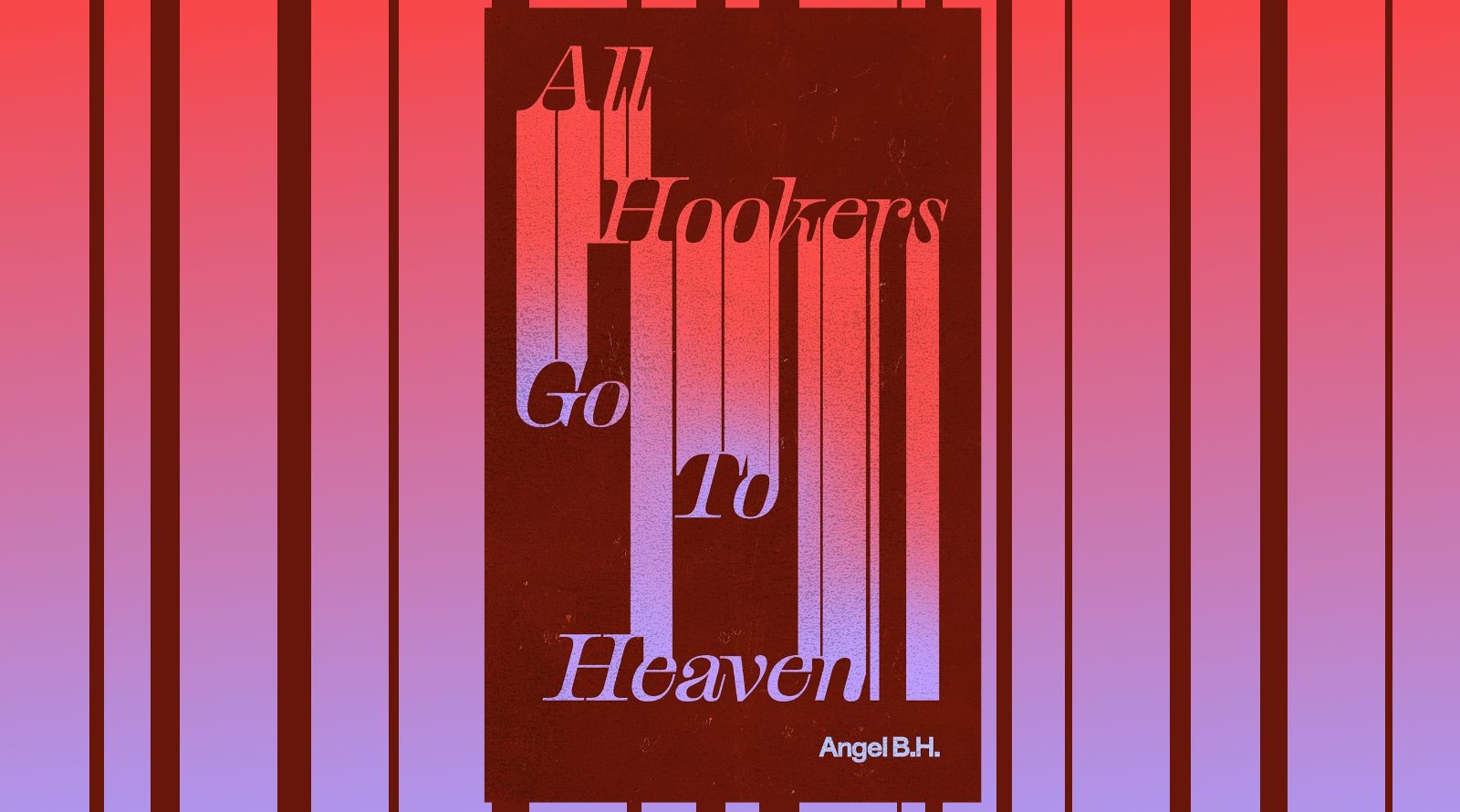
Editor's Note: Mentions SA of a sex worker and racist violence
When recounted with just the right emphasis, the parables of my own life are as vivid and far-fetched as any Biblical tale…they brim with turmoil and melodrama, sin and redemption, demons and angels alike. Possessed by the spirit of capitalism, we create our own mythologies.
— Angel B.H., All Hookers Go to Heaven
As a fellow former child of Christian fanatics, I approve this message! Magda, the central character of Angel B.H.’s semi-autobiographical novel All Hookers Go to Heaven, may be a stand-in for many sex workers. Not because of her white, Canadian, very bland, small-town background, but because of her transformation journey as a sex worker. In fact, were I to view the events of this novel through the archetypal “Fool’s Journey” from the Rider-Waite-Smith Tarot, the character of Magda as created by the author could be a paradigmatic “Whore’s Journey”: an archetypal metamorphosis from country-bumpkin closeted Christian virgin, to urban lesbian, to inappropriately shod Montrealian baby stripper, to fledgling New Orleanian escort, to Australian brothel worker, to international cosmopolitan professional companion. As we evolve, so do our working names: Magda is also Bambi, Zoe, and Fiona, changing names at a speed which only a sex worker can keep up with.
Much as in the tarot, these transmutations often come at a price. Though Magda’s burgeoning career as a sex worker is filled with a constellation of “angels”—fellow sex workers Starr, Local Opal, Lola, Steph, and Rory, who schooled her on the game or supported her in times of difficulty—the novel also recounts instances in which experience is the ultimate, unfortunate, teacher. Like Magda in her Bambi baby-stripper era, I learned the hard way to not drink too much at the strip club—Magda passes out in front of clients and gets fired, I got my heel caught in my underwear while drunkenly dancing onstage and then fell, same-same but different! Like Magda, I realised as a young escort that a client I imagined might care about me was exploiting me because he knew the game better than I did. The account of Magda’s detention at the United States border after an ill-fated work trip to Jamaica and her subsequent deportation back to Canada was nerve-wracking, but the most difficult to read portion of the book was that of a bad client named Axel during Magda’s first tour in Australia.
The character of Magda as created by the author could be a paradigmatic “Whore’s Journey”...
I was squirming uncomfortably and in suspense as the red flags surrounding Axel began to appear in the text: an initially generous, affectionate, and attractive client who quickly and surreptitiously becomes manipulative and obsessive before ultimately drugging and assaulting Magda. I found this story particularly powerful because Axel’s pattern of behavior could happen to anyone, sex worker or not—I know people across genders, civilians included, who have had the misfortune to encounter predators like Axel: men who are all the more dangerous for their self-pitying delusion that they are “in love” with the person they assaulted. There were all the same escalating elements of boundary-pushing and love-bombing before the assault that we’ve heard repeated in famous court cases and from the mouths of our own social circles. I invite any SWERFs reading the novel to consider that before trotting out the tired old “prostitution legitimizes/invites rape” argument.
More lightheartedly, Magda’s coworker Lola in Australia becomes her supportive rock after the assault. I often hear sex workers quote the African-American activist adage, “We take care of us”, and it has been as true for me in my career as a sex worker as it was for Magda in All Hookers Go to Heaven. The conditions of sex work, which can be as equally chaotic as they are comical, have the potential to foster bonds I have yet to find elsewhere. Something about the magical combination of seeing the inside of your coworker’s pussy plus making money with them plus having compatible personalities is a fertile ground for fast friendship (and extracurricular romance, as well). In fact, the dedication at the novel’s opening by the author reads: “To all the angels I have known.” This book is in honor of sex workers.
The conditions of sex work, which can be as equally chaotic as they are comical, have the potential to foster bonds I have yet to find elsewhere.
The most important relationships Magda builds throughout the novel, however, are those created with her renewed understanding of “faith”. Although she casts aside Christianity, sex work introduces her to a new companion, The Spectre, an amalgamation of Magda’s instincts who tells Magda what to do in difficult situations. As someone who lived through the abandonment of Christianity, I can relate to this process of relinquishing the self-abnegation of Christianity and discovering that we can, in fact, actually trust and find solace in the wisdom of our inherently spiritual and instinctive selves rather than in the spiritual father/husband substitute of God/Jesus. And although Magda does identify for a time as a “non-believer,” she does seem to eventually find comfort in the idea that there is a kind of higher power she can pray to and call on, even if it is not the Christian god she was raised with. Again, I can relate to this in my own way. The dedication I was raised to show towards Protestant Christianity has now shown up for me in my practice of Afro-Caribbean folk religion.
Ideas of faith and religion are constants alongside this narrative of a sex worker navigating the ups and downs of her burgeoning career. Magda’s name is short for Magdalena, which I can only assume is a nod to Mary Magdalene, who wasn’t actually a sex worker; there is frequent mention of “the Hustler’s Curse,” what some otherwise call an addiction to fast money; the author’s own pen name, “Angel” is its own oblique reference to spiritual themes. And of course, there are the angels the book is dedicated to. While I do hope one day we will have not only decriminalisation but also some kind of whore-school to learn the business from seasoned experts with on-the-job training, for now, like Magda I owe as much of what I know to the sex workers I’ve come into contact with over the years as I do to the lessons of pure experience (mistakes). Starr, Lola, Steph, Opal, Rory—they may become longtime friend-colleagues or be flash-in-the-pan teachers we never see again, but there are enduring lessons that fellow, more experienced sex workers give us in the form of advice (or insults with advice in them), which model the kind of sex worker we want to become.
Ideas of faith and religion are constants alongside this narrative of a sex worker navigating the ups and downs of her burgeoning career.
Were I to have any critiques of this divinely written novel, they would be one, the two characters I was most interested in were Starr and Storm, the elder BIPOC sex workers who appeared momentarily and then disappeared too soon. And two, if you are a white sex worker and witness a Black sex worker suffering a racist attack, verbal or otherwise, at work—even if the Black sex worker doesn’t outwardly react, that doesn’t mean it hasn’t affected us. As Black people, we are used to “liberal” white people standing by silently “in shock” while racial epithets are thrown at us, and then them coming to commiserate with us after the damage has already been done. If you wish to be in solidarity with a Black sex worker in a situation like the one that occurs with Starr in the novel, stand up for us in the moment. We are tired of having to constantly defend ourselves alone and then receive your sympathy afterwards. We may not yell back at a racist strip club owner with underworld ties because we know that as Black women, we are considered disposable and could put our lives in danger by doing so. Use your white shield. You can be somebody’s angel too.
To buy All Hookers Go To Heaven, visit Invisible Publishing.
B🧿 Empress Mirage, also known online as thepasteldomina, is the creator of 'the sex/work & magic digest' newsletter on Substack🔮💅a blog of literotica and musings on sexual witchery (sex workers can receive an 80% off annual subscription anytime!) Her writing has also appeared in the Tryst.link blog, PetitMort, and PolyesterZine.
A Note to Our Community: The Tryst.link blog is not affiliated with or endorsing any sites, brands, or products linked here. We share resources only where we feel they might add real value to sex workers’ knowledge or autonomy—and when the benefit feels worth the risk.
If you love sex worker memoirs, check out our reviews of Rebel Girl by Kathleen Hanna, In My Skin by Kate Holden, and Neon Girls by Jennifer Worley.
Are you a sex worker with a story, opinion, news, or tips to share? We'd love to hear from you!
We started the tryst.link sex worker blog to help amplify those who aren't handed the mic and bring attention to the issues ya'll care about the most. Got a tale to tell? 👇☂️✨







)
