
Editor’s note: mentions of racial stereotyping
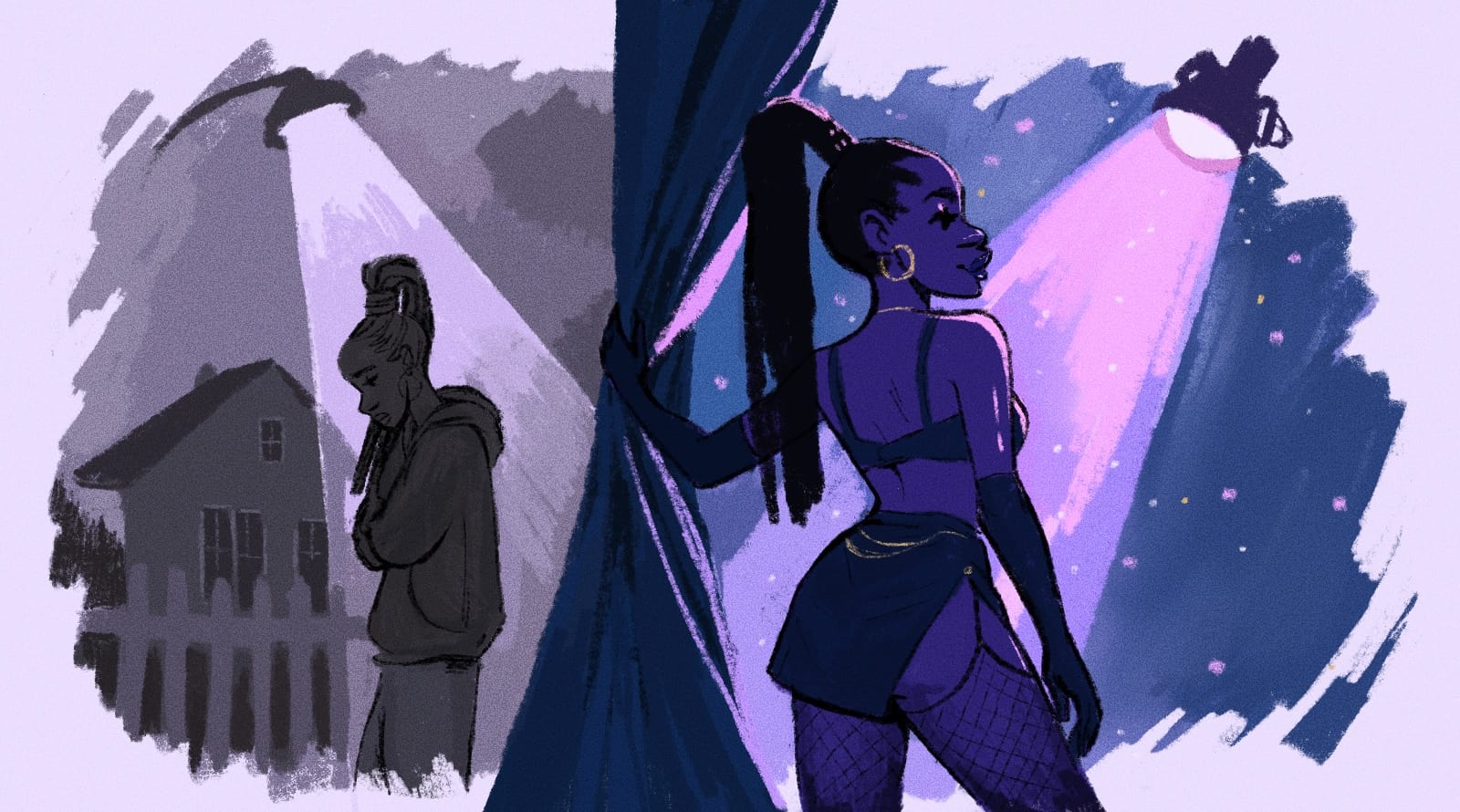
As a Black girl growing up in a suburb, I grew up with rules before I even understood why they existed. But these rules weren’t made for me—they were framed as protection from the male gaze, protection from being labeled “fast.” They were protecting my reputation and by extension the family name. My body became something to regulate so that men wouldn’t sexualize me, the community wouldn’t judge me. I questioned myself a lot: did folks like me for me, or for my body?
My body was constantly interpreted by other people, before I could understand it myself. As a teenager, things like spaghetti straps, fishnets, short shorts, and short skirts were treated as statements about my morality. Let my granny tell it; they made me “look like a hooker.” I learned early how quickly a Black girl’s body gets assigned meaning, and how little of that meaning will come from her.
Shrinking to fit whatever role white folks were comfortable putting me in that day became second nature. Code-switching became survival. I learned how to be the only one in the room, how to be readable in the “right” way. Respectability became something I performed without realizing I was performing it.
I learned early how quickly a Black girl’s body gets assigned meaning, and how little of that meaning will come from her.
The male gaze didn’t start with sex work. It was present in the way I was constantly trying to escape stereotypes, when I should have been embracing my innocence and curiosity. There was always a pressure, spoken and unspoken, to uphold a high standard as though I alone was the representative for my entire race. In some spaces, I am. I became hypervigilant with my looks, how I talk—oh, don’t get me started on how I talk—how I move, who I move around, and how all of it might be read by others. I learned what it meant to be seen before I ever had the chance to decide how I wanted to be seen.
Sex work complicated that relationship.
It did not erase what I had been taught about my body. It did not remove the weight of being a Black woman in a world that constantly has opinions about Black women’s bodies. But it gave me something I had not always had before: a sense of control over the gaze.
Through sex work, I started to understand desire differently. I was able to see myself without it being filtered through my baseline: awkwardness and anxiety. In regular life, I can be very much in my head—Why did I say that? Can I become invisible now? How am I coming across? How am I being read?—I can feel disconnected from my body under the weight of self-awareness. My second life—that’s what I call my sex work space—gave me a structured place to step out of that loop. It has provided a space to play, to be sexual, flirty, dominant, or to explore fetish without constantly second-guessing myself. I can be present and intentional.
There was always a pressure, spoken and unspoken, to uphold a high standard as though I alone was the representative for my entire race.
There’s a difference between being sexualized and choosing to be sexual. For a long time, those two things felt connected because so much of my relationship with my body was shaped by other people’s reactions to it. Being perceived as desirable did not always feel empowering. Sometimes it felt like another way of being misunderstood.
Sex work forced me to seperate those ideas. Desire did not have to mean losing control. Being seen didn’t automatically mean being consumed by someone else’s expectations. I could create boundaries, decide what parts of myself I wanted to share, and I was able to recognize that my body could and should exist outside of shame.
That’s something I’m still learning honestly, albeit slowly. I spent so much of my life trying to make myself smaller, safer, and easier to accept. I'm learning how to anticipate discomfort before it happens; how to read the room before I even asked myself what I wanted. In my second life, I have started practicing something different: asking myself what I want first. In that space, something has shifted. It isn’t just about escaping the white gaze or the pressures that come with it anymore. It’s about reclaiming it. I have control over how I show up, when I show up, and how I want to be perceived.
Being seen didn’t automatically mean being consumed by someone else’s expectations.
As a Black woman in America, that space is deeply important. I regain autonomy over my image, my body, and my voice, and I am met with affirmation instead of correction. I don’t feel that kind of peace in everyday life (and definitely not in Suburbia). There is always respectability to manage, stereotypes to navigate, and expectations to meet before I can fully exist as myself.
In my second life, the pressure has shifted. I am no longer only being interpreted, I’m participating in how I am perceived. I get to decide how I show up, how much emotional labor I give, what I offer, and what I keep for myself. That choice isn’t always simple, but it is mine.
Maybe that is the core of it. I do not like being watched in everyday life. In most regular spaces, I prefer to feel invisible, like I am moving through the world without a target on me. Without being read, without having to think about how I am coming across every second.
But in sex work, it is different. I choose it instead of it being imposed on me. That makes all the difference.
For more articles on the experiences of Black sex workers, see Dismantling and Reclaiming Stereotypes as a Black Domme and The Joyful Resistance of Miss Major Griffin-Gracy. To find more articles from a BIPOC perspective, check out this tag.
Are you a sex worker with a story, opinion, news, or tips to share? We'd love to hear from you!
We started the tryst.link sex worker blog to help amplify those who aren't handed the mic and bring attention to the issues ya'll care about the most. Got a tale to tell? 👇☂️✨




)