
Editor’s Note: non-detailed mention of childhood sexual assault
The Seven Year Itch is a romantic comedy from 1955. [1] The movie stars Marilyn Monroe as “The Girl” alongside Tom Ewell as Richard Sherman, and Evelyn Keyes as Helen Sherman. [2] Though this film does not have a plot around sex work explicitly, it explores themes that come up for sex workers. With Marilyn Monroe as the star, we can also explore her life and career as inspiration to our community.
As well as being lighthearted and adorable, with great fashion and aesthetics, The Seven Year Itch covers some familiar themes in a very interesting way.
When it comes to the question of infidelity (in a monogamous marriage), I really appreciate that this film focuses on portraying the man cheating (or in the position to cheat) as the mentally unstable one (or “imaginative” as they call him). It is he who bears the moral responsibility rather than either of the women involved. His wife, Helen, is trusting. The other woman (played by Marilyn) is sweet and mostly innocent throughout the film.
It is so refreshing to not have either woman portrayed as causing “the problem” of infidelity. Often, either woman can be blamed in either the role of so-called homewrecker, or as the wife who isn’t caring well enough for her husband. The person cheating should be the one having to reconcile for their actions, but so often when it’s a man cheating, a woman gets blamed.
It is so refreshing to not have either woman portrayed as causing “the problem” of infidelity.
As a sex worker, I often see other sex workers trying to explain the fact that some of our clients are married. I usually don’t enjoy this topic of writing, because from my point of view, it doesn’t matter. It’s not my responsibility. I am not married. It’s not my commitment. As someone who dates polyamorously in my personal life, I don’t believe that we can confidently assume everyone married is monogamous. We don’t know what each couple’s definition of cheating would even be. We can’t possibly know their agreements. The morality essays and discussions around sex workers having some married clients frustrate me because they reinforce ideas around monogamy being the norm and blaming a third party for infidelity.
The Seven Year Itch may have been released in 1955, yet it does a better job than our modern media of placing the responsibility of fidelity where it belongs—in the person in the committed relationship who is facing temptation. However, the film does include a few 1950s cringe moments in its portrayal of Indigenous people, and of “The Girl” whose character assumes that jealousy equals love.
The film’s point of view is that of the husband, Richard. It shows his inner thoughts, fantasies, and his struggle of trying to stay true to his wife. It shows him contradicting himself in both his thoughts and decisions. It shows him ruminating fearfully about various scenarios that could come up if he were to act on his fantasies. It shows him nervous and hallucinating. Throughout history, whether in cinema and real life, women are portrayed as letting their feelings drive them to a negative impact on their decision-making or mental wellbeing. This film shares that quality with a man, through the main character’s behavior. Richard’s experience can and does happen to everyone. Men are just as susceptible to having emotions and being affected by them as women are. Having emotions is a human experience, not a gendered one.
Throughout history, whether in cinema and real life, women are portrayed as letting their feelings drive them...
One of my favorite moments in this film is “The Girl” admitting that one of the reasons she likes married men is that “he can’t possibly ask you to marry him” because he is already married. I fully relate to this sentiment. I think this moment echoes Marilyn’s personal life as well—she was married three times; each marriage ended because she chose her career, and a level of independence whenever her husbands gave her ultimatums that were rooted in insecurity.
Marilyn’s life experiences, her career choices, her acting, and character persona are all contributions that we can appreciate as sex workers and feminists. Before becoming an actress, Marilyn posed as a pinup model. Her modeling work allowed her to leave her first husband, Jimmy Dougherty, who she had married at just 16 years old to get out of the foster care system. [3]
In 1949, Marilyn posed nude for an art calendar in exchange for $50. [4] If we think about sex work as an umbrella term, Marilyn’s experiences would most likely qualify, especially considering the time in which she was working—the 1940s to 1960s. During her acting career she faced criticism for posing nude, and studio executives even recommended she lie and claim the photos were of someone who looked like her. Marilyn, being her own promotional genius, did the opposite, sharing honestly about her difficult choices as a young single woman, which only helped her image. [3]
Many of us can relate to the way the character persona of Marilyn was carefully curated by Norma Jeane Mortenson (Marilyn’s given name). The character “Marilyn” acts not only as great marketing, but as a form of protection, keeping some aspects of her true personality hidden from the public. Her crafted persona and use of exaggerated femininity surely allowed her to take back some control of her life choices from the men who tried to dictate them, which included film studio executives and her three husbands. [3]
Many of us can relate to the way the character persona of Marilyn was carefully curated by Norma Jeane Mortenson...
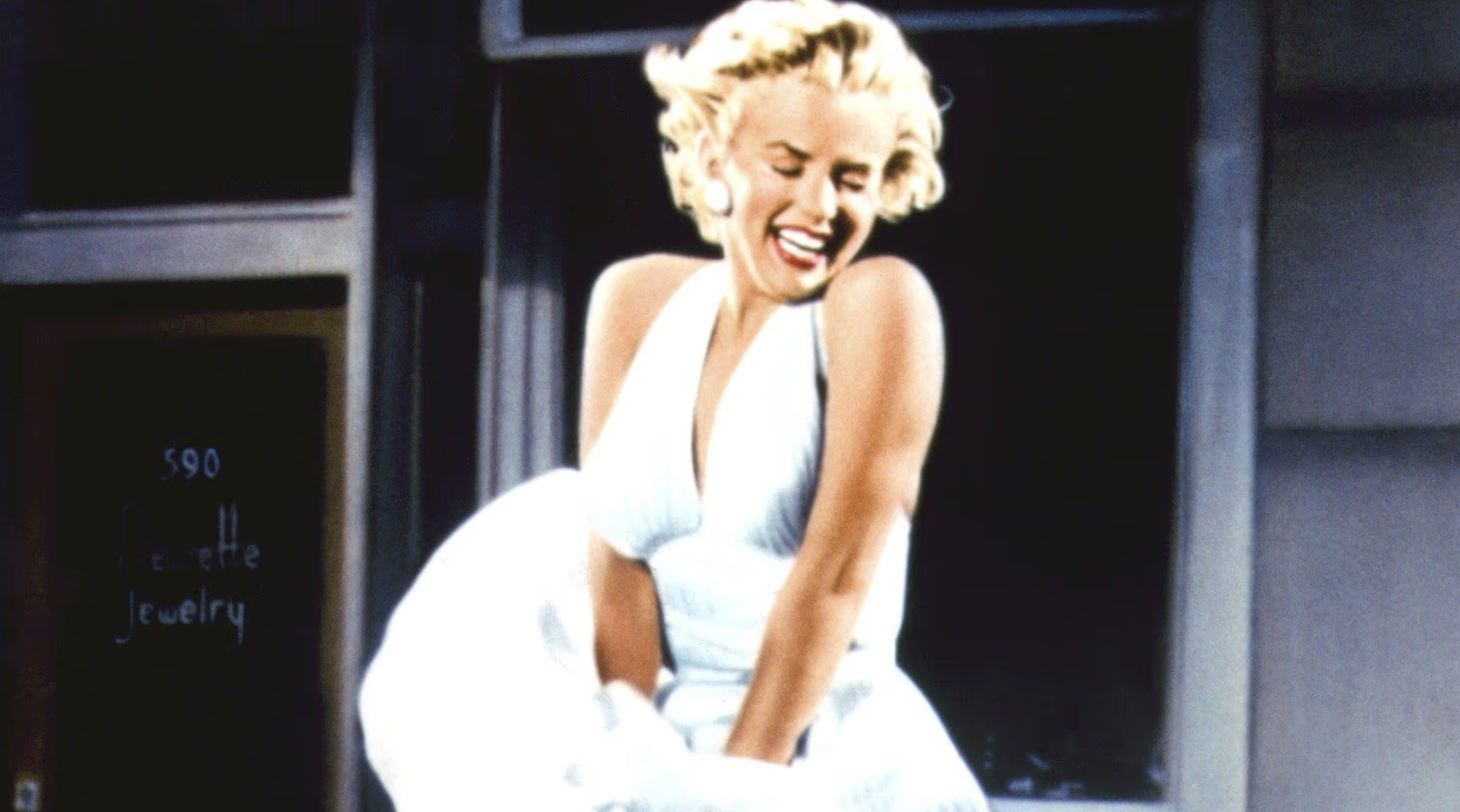
In The Seven Year Itch, Marilyn stands over the subway grate in a pleated white halter dress—an iconic moment in fashion, also captured on film. Marilyn appeared to think of this moment regretfully, once explaining to her friend, actor Eli Wallach, “That’s all they think of me now.” The shooting of Marilyn’s dress “teaser” was leaked by the film’s director, Billy Wilder, resulting in her being bombarded by crowds and photographers for the rest of the shoot. Following this, Marilyn demanded approval on all scripts and directors for future films. [5]
Marilyn is a feminist icon; she advocated for herself in an industry where much of the decision-making was still being led by men. She also used her star power to advocate for other marginalized women of her era. She advocated for Ella Fitzgerald to be given the stage at Mocambo nightclub in Los Angeles, during a time of racist Jim Crow laws, hiring practices, and attitudes that persisted in all jobs, including entertainment. [6] Marilyn promised to attend the club each night and have her photo taken, in exchange for Ella Fitzgerald being given the stage. Marilyn also spoke out about her sexual assault as a child to let others who shared this experience know they were not alone. [3]
The Seven Year Itch is a new favorite. With Marilyn being a younger woman, the other woman, and overall, an innocent, fun, sweet, funny character, I find her instantly relatable in this role. Whether I’m doing sex work or personal dating, people cheat, and the fact that I’m either trying to work or have some fun, should not place blame of any infidelity on me. I never signed up for a monogamous relationship. I am not accountable for a relationship I’m not a part of—just like Marilyn as “The Girl,” and just like anyone else who has ever found themselves in the role of “the other woman.”
Marilyn is a feminist icon; she advocated for herself in an industry where much of the decision-making was still being led by men.
I find Helen to be an inspiration as well. Her cool, clear-headed view of her own relationship and her trusting, nonchalant demeanor are all things that I think everyone should aspire to in a relationship. She has her son to take care of, a vacation to be had, and she can’t be bothered to worry over whatever fantasies and ruminations Richard might be having in the summer heat. Helen has a healthy relationship attachment style and it’s one that we should all strive for.
Sources:
1. The Seven Year Itch. Dir. Billy Wilder. Perf. Marilyn Monroe, Tom Ewell, Evelyn Keyes. Charles K. Feldman Group and Twentieth Century Fox, 1955. Streaming Tubi. https://tubitv.com/movies/100006011/the-seven-year-itch
2. IMDB. Review of The Seven Year Itch, by Billy Wilder. Web. 11 April 2026. https://www.imdb.com/title/tt0048605/
3. Bailey, Kaytlin & McLellan, Justine T. “Marilyn Monroe.” Host Kaytlin Bailey. The Oldest Profession Podcast. Old Pros. Web. 11 April 2026. https://oldprosonline.org/marilyn-monroe/
4. “Marilyn Monroe’s life and career timeline.” PBS. 19 July 2006. Web. 11 April 2026. https://www.pbs.org/wnet/americanmasters/marilyn-monroe-career-timeline/62/
5. Hanks, Tara. “’The Seven Year Itch’ at 70.” Review of The Seven Year Itch, by Billy Wilder. The Marilyn Report. 3 June 2025. Web. 11 April 2026. https://themarilynreport.com/2025/06/03/the-seven-year-itch-at-70/
6. Evon, Dan. “Did Marilyn Monroe Help Ella Fitzgerald Book Mocambo Gig?” Snopes Fact Check. 2 Dec. 2019. Web. 19 May 2026. https://www.snopes.com/fact-check/marilyn-monroe-ella-fitzgerald/
Are you a sex worker with a story, opinion, news, or tips to share? We'd love to hear from you!
We started the tryst.link sex worker blog to help amplify those who aren't handed the mic and bring attention to the issues ya'll care about the most. Got a tale to tell? 👇☂️✨





)
%20If%20I%E2%80%99m%20a%20Puta%20%2F%20Putafeminista%3F)