
Editor’s Note: mentions racism and transphobia, references murder of trans women
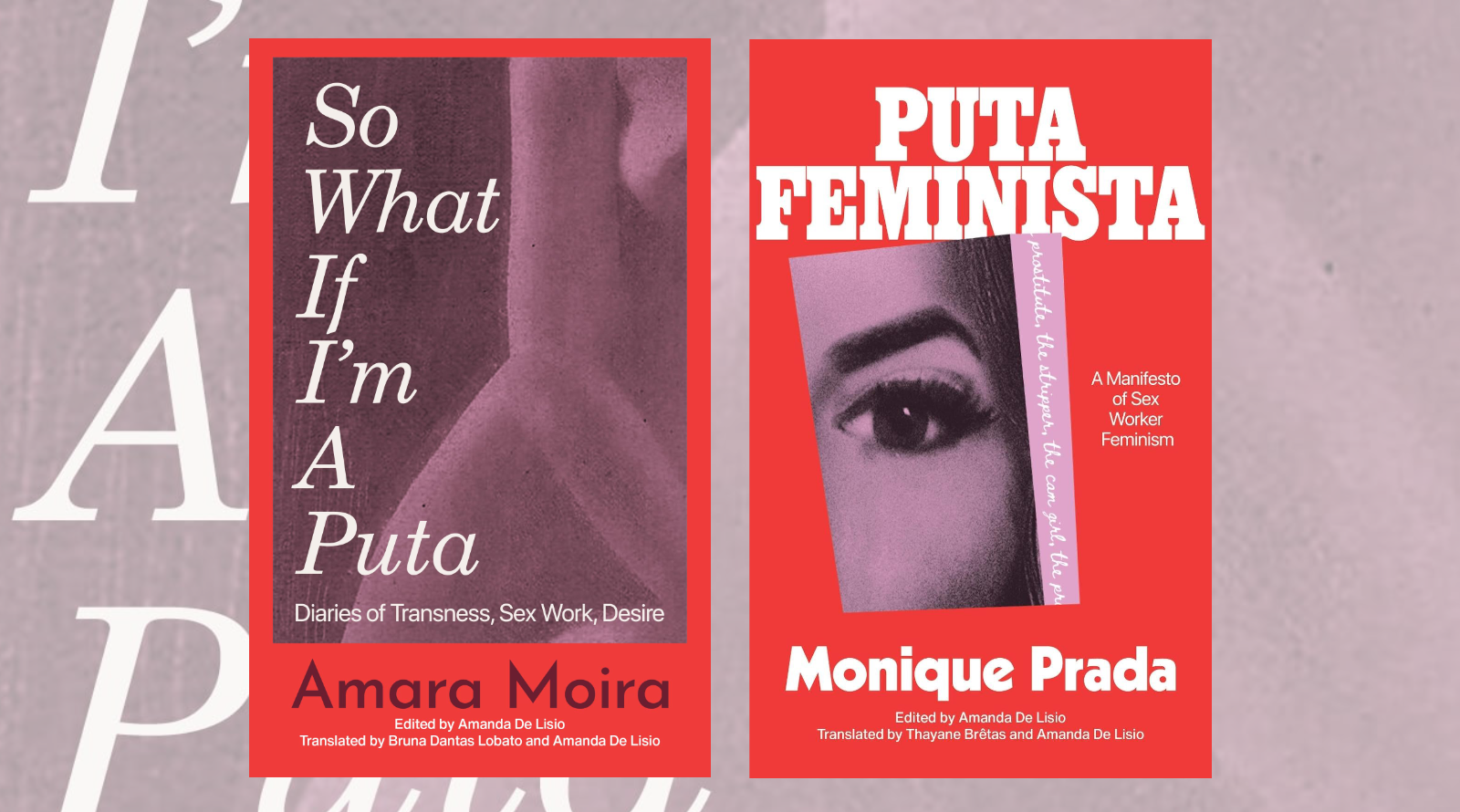
Recently, I finished reading both Amara Moira’s (So What) If I'm a Puta? (2025) and Monique Prada’s Putafeminista (2025). Both texts have recently been translated from Brasilian Portuguese into English. According to Prada, Brasilian activist Indianarae describes Prada and Moira alongside themself, as the “putatrinity” of sex work activists in Brasil. I chose to review these books in conversation with one another: Moira wrote the foreword to Prada’s book, and Prada was in turn inspired by Moira’s book in creating Putafeminista.
In fact, reading Putafeminista changed my perspective on (So What) If I'm a Puta? As I posted cryptically on my Substack immediately after finishing it, I didn’t much enjoy Moira’s book at first. Why? My first impression was that the revelatory nature of Moira’s forty-four essays about her street-based sex work, adapted from her online blog of the 2010s, reflected too much the kind of sex worker memoir I feel I have had enough of: an educated white woman enters sex work, gives civilians an unfiltered glimpse of the subaltern sex they crave. In Prada’s words, the obsession of civilians with knowing about the lives of sex workers is a chance to, “peek through the keyhole without getting splashed,” a metaphor I would describe as wholly accurate.
I now realise that I judged Moira, as she wrote about being judged by other putas who told her she was just “a tourist” and “not a real puta.” And it surprised me to read that Prada had faced the same critique from other putafeminista activists who worked on the street, and saw Prada’s escort agency work as illegitimate putisma: "Within the prostitutes’ movement, the greatest offense is for someone to say that you’re not a prostitute."
Reading Putafeminista changed my perspective on (So What) If I'm a Puta?
But is it about time, or is it about tricks? Who gets to be a puta? Both Prada and Moira discussed the divide between the adoption of the term “sex worker” by those outside of Brasil and the attachment to the term puta held by many Brasilian putas, with Moira describing this dynamic beautifully in her foreword to Prada’s book:
"...nothing is transformed by a simple change in words. Words, despite my wishes, do not have this power, and cannot make people who have been prostitutes their whole lives become, at the snap of a finger, sex workers or sex professionals. This sanitization, this forgery, and the impression of academicism—in addition to the fact that many of us still assume the official, derogatory view of our profession—explains the resistance to such linguistic proposals."
To be clear, Moira’s (So What) If I'm a Puta? differs greatly from the standard tell-all memoir by a sex worker because she is a trans woman working on the street. I think my issue with the book’s content was because I initially felt the stories she told fitted the latter binary of sex work narratives as described by Prada: “For the voices that society considers worthy of hearing, either space is given to a glamorous and fanciful portrayal of prostitution, or a dramatic depiction of the prostitute as a suffering victim.” Moira’s stories are of clients who disrespect, cheat, and harm her, as well as consistently disregard her humanity. But she is telling the truth. Prada transformed my view on Moira’s tales. I now admire how Moira exposes those who never imagined this “puta would dare to speak.”
Is it about time, or is it about tricks? Who gets to be a puta?
The concept of the “puta who dares to speak” is one of the most critical observations Prada makes in Putafeminista which elevated my thinking about Moira’s work:
"...What putas are these, who dare to speak and challenge everything that is thought of them? On top of that [what kind of putas] dare to expose themselves without disguises, not just on social media but also in person, in public debates?"
Moira reflects in her book how her clients would never even think that the puta they are with could pick up a pen or laptop and describe them so well. “If they had,” she mused in one of my favorite passages, “maybe they would have treated her better.”
According to Prada:
"...Transgender Europe named Brazil as the most lethal nation for travestis and transgender people in the world, and reveals another frightening fact: more than half of the trans women murdered between 2008 and 2016 in Brazil practiced prostitution, ninety percent of all trans women and travestis engage in prostitution in Brazil."
Moira, a PhD candidate and a writer working the street, creates a subliminal exposure of the way in which “classic Brasilian family men”—a phrase also echoed by Prada—think they can treat a transgender sex worker.
Indeed, one of Prada’s most stunning a-ha moments for me was how she discussed sex work as irrevocably connected with the domestic sphere. The archetype of the “father” as it were, is the archetypal client. Moira even reflects on—which gave me pause—how her desire for them to have better hygiene before coming to see her could be a form of “elitism.” How could they shower, where would they find the water to do so: these day laborers for whom the R$20 or R$30 of Moira’s standard fee at the time of her writing is perhaps a lot of money from their scant wages already? It was interesting how she could still find the capacity to consider the humanity of her clients, even when so many of them were unkind—to put it gently—with her.
I realised, once Moira’s (So What) If I'm a Puta? was contextualised within Prada’s Putafeminista, that I was participating in a game I have accused others of playing: discouraging sex work narratives including honest depictions of sadness or violence out of concern that it’s all the civilians think we are. It is important that we nourish a healthy ecosystem of putanarratives to prevent there from being just one assumed reality of sex work. To paraphrase Prada, if one puta says something, it’s as if we have all said it. Moira is describing her own unique reality as a transgender woman with a university education doing street-based sex work—there can be no putasingularity. Her reality includes the valid way she communicated feeling affirmed as a woman through her desirability as a sex worker.
One of Prada’s most stunning a-ha moments for me was how she discussed sex work as irrevocably connected with the domestic sphere.
I feel part of my disaffinity with aspects of both Prada and Moira’s book was the lack of Afro-Brasilian presence in them. Of course, these two women are white Brasilians from middle-class backgrounds, and they each acknowledge that positionality. Afro-Brasilian women are mentioned twice in Prada’s book, once with the luminous beauty that is Célia Gomes, an Afro-Brasilian putafeminist and artist, and the non-sex work related Black feminist scholarship of Lélia Gonzalez. Prada, to her credit, discussed the wage gap between white and Black men in Brasil at the time of her writing—but she neglected to ruminate on how the wage gap must persist between white and Black sex workers in Brasil.
Who are the putas we want to hear from? Probably, the ones who reflect our own experiences. I may have more in common with Moira than I thought, since her line, “Now, I don’t quite know anymore if I am a sex worker to write, or if I write to do sex work,” hit home for me. I admire Monique Prada, whom I have never met, but wanted to cheer her on as she described pulling her panties to the side for the audience to “check” to see if she still had her pussy, during a debate with a SWERF who claimed that Prada had sold her body. Prada’s framing of the sex worker name as our nom de guerre, or “war name,” in the putafeminista activist struggle resonated with me deeply, as did her illustration of the ways in which she was initially “seduced” by mainstream feminism before being forced to reject it.
Prada has made important lines of thought in Putafeminista, which I now see as one of the must-read tomes for those of us in sex worker activism; she has highlighted the way in which it is easier for governments to focus on ending sex work rather than admitting that they have failed to end poverty; she has noted the ways in which prostitution continually reinvents itself to avoid being eradicated completely; she has emphasized the way the internet acts as our portal to a global movement of sex worker activism; she has turned our gazes towards the incredible activism and movement work of sex workers in Brasil; finally, she has neatly torn to shreds with razor-sharp precision every stupid argument a SWERF may have and served the tattered pieces of it back to them on a platter with a smile. I recommend both of these books, but especially Putafeminista by Monique Prada for that SWERF in your life. You can hand it to them with a smirk, quoting Amara Moira’s foreword to Putafeminista: “Yes, we want everything—all the rights—and we needed it yesterday.”
Bio: B🧿 Empress Mirage, also known online at thepasteldomina, is a 5'8" goddess specializing in financial domination. She is a writer of smut and cultural commentary, as well as a former fssw, bondage model, and stripper. She is the creator of 'the sex/work & magic digest' newsletter on Substack🔮💅a blog of literotica and musings on sexual witchery (sex workers can receive an 80% off annual subscription anytime!) Her writing has also appeared in the Tryst.link blog, PetitMort, and PolyesterZine.
For more reviews of sex work books, take a look at Freedom & Prostitution by Cassandra Troyan, Untold Intimacies: A History of Sex Work in Aotearoa, and Neon Girls.
Are you a sex worker with a story, opinion, news, or tips to share? We'd love to hear from you!
We started the tryst.link sex worker blog to help amplify those who aren't handed the mic and bring attention to the issues ya'll care about the most. Got a tale to tell? 👇☂️✨





%20If%20I%E2%80%99m%20a%20Puta%20%2F%20Putafeminista%3F)

)
