
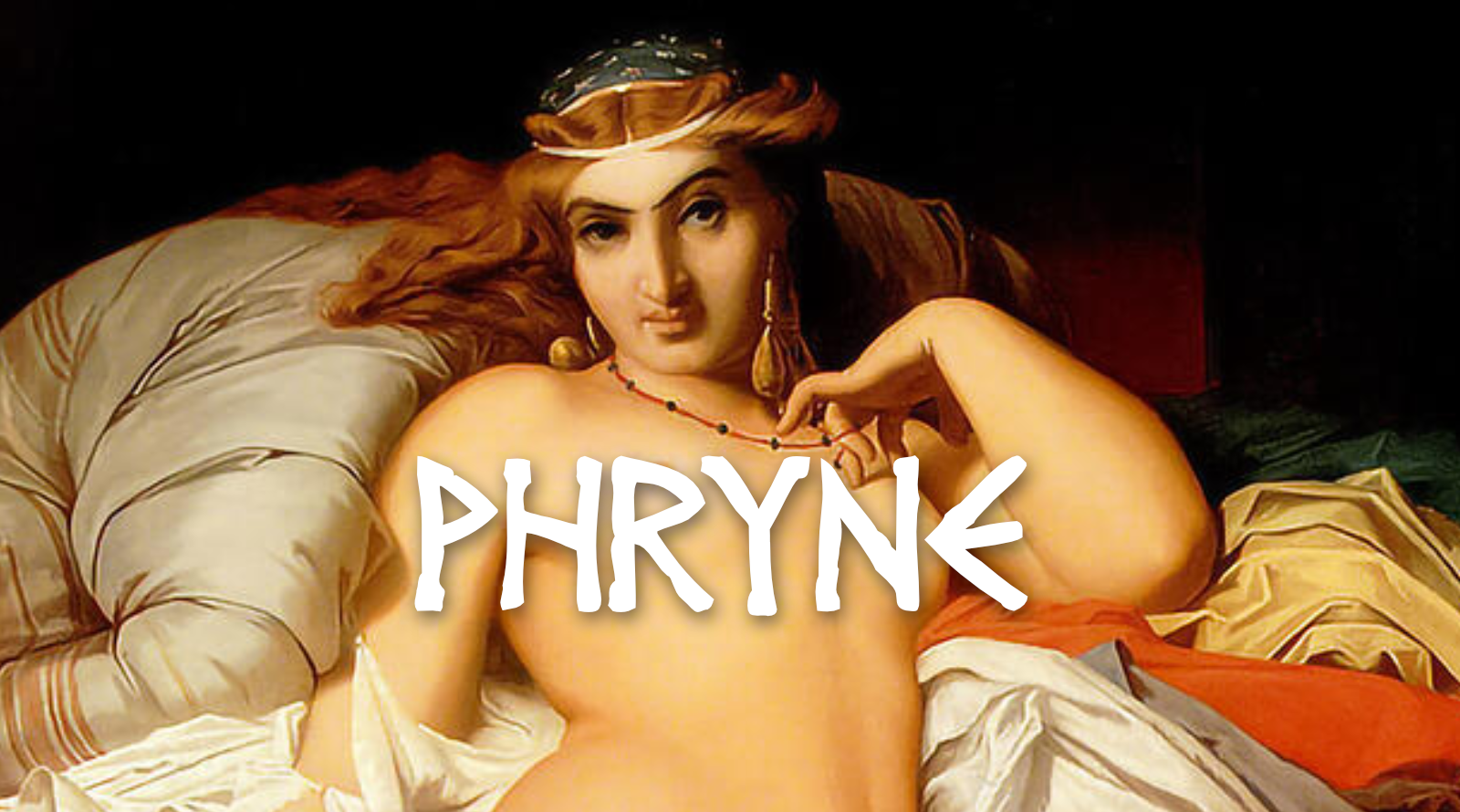
Like many neurodiverse queer baddies, I am obsessed with Ancient Greek mythology. Their gods are relatably messy and extremely fascinating, and so too were the people who worshiped them. Let’s talk about an historical baddie who deserves recognition—the ancient Greek courtesan Phryne.
Setting the scene: Sex work in Ancient Greece
A patriarchal society, Ancient Greece had complicated attitudes towards sex work that both complement and contrast with our modern-day counterparts. The Madonna-whore complex, a construct that still applies today, reflects how women during this period were organised socially into the role of “the wife” or “the whore”.
The word pornai, which translates to “to sell”, referred to a distinct category of slave women and foreigners. Those who were outside of the category of male guardianship could be branded as whores, as well as prostitutes. Much of these attitudes had been carried over from Mesopotamia and Ancient Egypt, with the Old Testament describing a prostitute by stating, “She is loud and stubborn; her feet abide not in her house; now she is without, now in the streets and lieth in wait and every corner” (Proverbs 7:11–12).
Those who were outside of the category of male guardianship could be branded as whores, as well as prostitutes.
Sex workers during this period were divided by class. The lowest ranking were the pornai, who worked in brothels and in the streets, and the highest ranking were referred to as hetaerae, or companions of the wealthiest and the most noble of Greek men. So respected were the hetaerae that they were able to walk about the streets unveiled, their faces painted to signal their role as hetaerae. Pornai provided sexual services only, whereas hetaerae were considered to be cultured and educated women who were able to provide intellectual stimuli and companionship.
Men during this time flaunted their hetaerae with pride, as a status signifier. While wives were at the mercy of their husbands, forced to reside in the home, hetaerae possessed much more freedom and autonomy over their lives. Many hetaerae lived alone, or in small groups or pairs (history would call them “roommates”), they were selective about whom they took company with, and were able to engage in political and philosophical discussions with their male counterparts. Many hetaerae would serve as muses to influential men of the time, one of the most famous examples being Phryne.
Aphrodite in human form
Not much is known about her early life, but many scholars argue that Phryne was born from humble beginnings in the city of Thebes. Her birth name is believed to be Mnesarete, but due to her pale complexion she was often compared to a toad (known as Phryne). This is believed to be where the name Phryne comes from, used ironically to highlight her beauty compared to a toad.
Comparable with an attractive small-town girl moving to Los Angeles, she would relocate to the city of Athens, where her beauty and intellect quickly opened opportunities to establish herself as an influential hetaerae. She was the “it girl” of Athens, catching the attention of many famous Athenian men, including Hypereides the logographer and orator, Apelles the painter, and Praxiteles the sculptor.
It wasn’t just her beauty that made her stand out, she possessed a sharp wit, and a natural ability at holding a conversation. This helped her gain the respect of the Athenian men she surrounded herself with, who typically saw women as “less than,” and unworthy of engagement beyond their household duties. Her sharp tongue could be used against the men around her. According to The Deipnosophists (written by Athenaeus around AD 200), Phryne is engaging with a potential client in which she states the price for her company. When he complains that the day earlier she had charged half the price of that to another client, she responded by saying, “wait till I want you, and I will take the same from you.” Oof, burn!
It wasn’t just her beauty that made her stand out, she possessed a sharp wit, and a natural ability at holding a conversation.
Her beauty was so renowned that she became famous for impersonating Aphrodite, the goddess of beauty, desire and prostitution. At the annual festivals of Poseidon, and Aphrodite, Phryne would famously perform a ritualistic striptease in honour of Aphrodite. Standing at the steps of the temple in her usual dress, she slowly derobed herself as onlookers gazed upon her naked beauty. She plunged into the seaside, emerging from the seafoam like that of Aphrodite’s legendary myth. The crowd erupted into chants of pure ecstasy, while Phryne vanished into the temple. In the eyes of the people of Athens, this ceremonial striptease made her the living embodiment of Aphrodite, a highly respected deity whose wrath was as feared as any other goddess. To compare a mortal woman to Aphrodite risked being seen as a disrespect to the goddess, so this comparison speaks to just how highly respected Phryne was.
Many believe Phryne to have been the muse behind the famous statue Aphrodite of Knidos by Praxiteles. This art piece would forever change Ancient Greek art, as prior to this, female nudity (especially in the form of a goddess) was not portrayed in statues. While there is no solid proof that Phryne is the model for the statue, her proximity to Praxiteles, alongside her being seen as the living embodiment of Aphrodite, makes this assumption easy to digest. Regardless of whether she was the model or not, her comparison to the goddess still remains one of her defining features.
The infamous trial
As we see time and time again in history, a powerful woman will quickly become the receiver of accusation and scrutiny. Because of her public impersonation of Aphrodite, Phryne was accused of impiety; a crime against the gods. This was a capital offence, which meant that if found guilty, she would be sentenced to death. To add even more drama to this dramatic turn of events, her defence was one of her influential clients, Hypereides. She was up against an all male jury, who seemed hell bent on a guilty verdict.
Just as it seemed all hope was lost, Hypereides did something that would go down in history. He turned to Phryne and ripped her robe from her, revealing her naked body to the jury. A stunned silence took hold of the room, with the ancient writer Athenaeus noting that the men appeared "seized by a superstitious fear.” Hypereides argued that such beauty could not be possessed by someone so wicked, that Phryne’s beauty was a sign that she was divinely favoured, and to condemn her would be the equivalent of condemning Aphrodite. As ridiculous a notion as this may seem by today’s standards, it worked. Out of fear of divine retribution, Phryne was acquitted of all charges.
Just as there is no solid proof that Phryne was the model for Aphrodite of Knidos, many scholars argue that this trial is the work of fiction. Regardless of whether or not it is true, Phryne was very much a real historical whore. Having come from humble beginnings, she worked her way up to a life of luxury and respect. In a time in which women had little to no rights, Phryne rose above the restrictions of her gender and gained a life of independence. If I could have dinner with three historical figures, she would without a doubt be one of them.
For more on sex work and mythology, check out Exploring Mythology with Vixen Temple and Harnessing the Power of The Dark Goddess in Sex Work.
Are you a sex worker with a story, opinion, news, or tips to share? We'd love to hear from you!
We started the tryst.link sex worker blog to help amplify those who aren't handed the mic and bring attention to the issues ya'll care about the most. Got a tale to tell? 👇☂️✨








)
