Editor’s Note: non-detailed mention of child slavery and sexual abuse
It’s 1899. Paris. The cobbled streets of Montmartre are strumming with creative spirit. Or green and grim with absinthe and illness (depending on who you ask). Rising out of the district like a cherry-red citadel is the “Moulin Rouge”, a nightclub, cabaret bar, and (say it quietly) a luxurious bordello. It is flanked by a fantastical architectural elephant, ornately decorated and spotted with softly-lit lanterns.
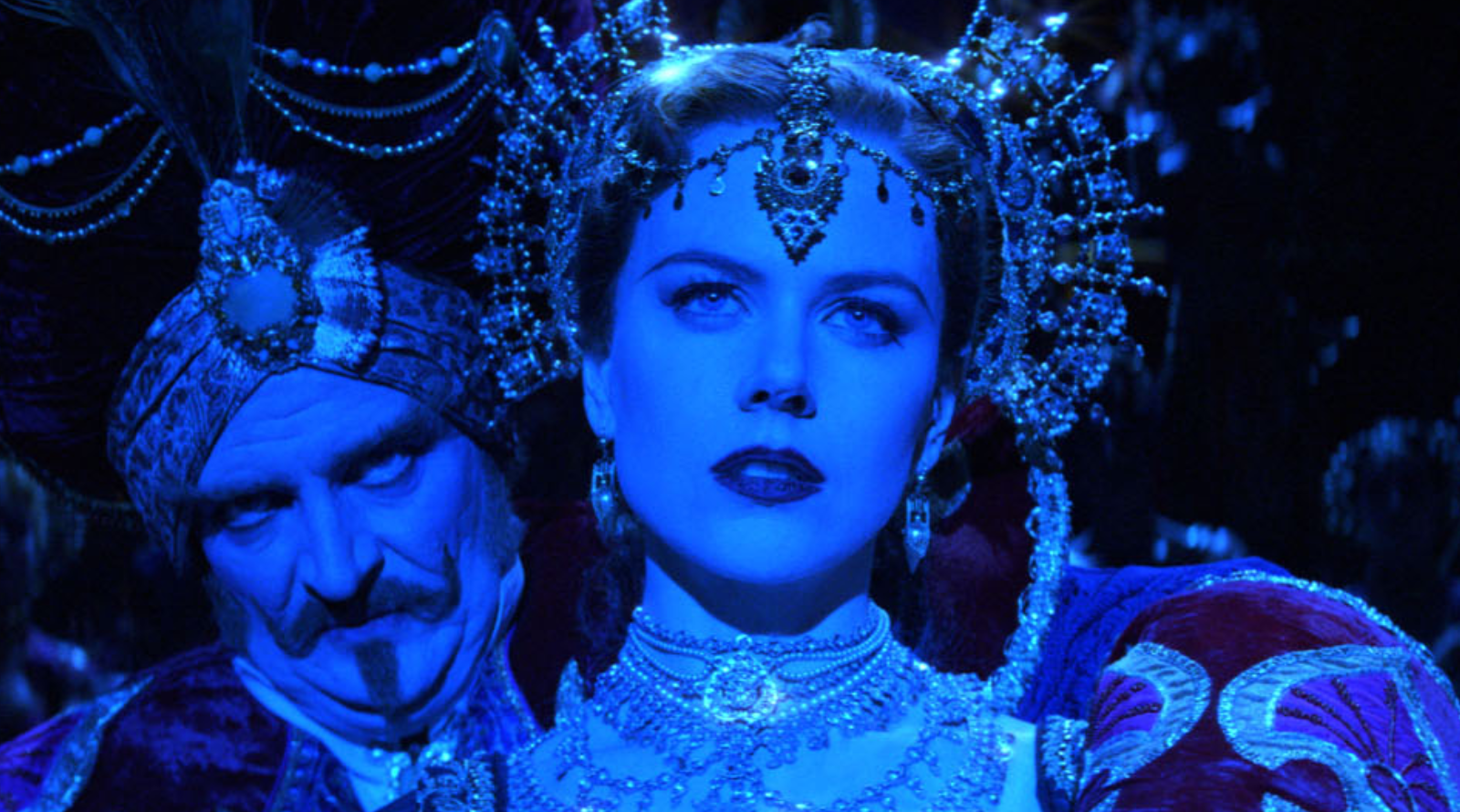
There was such an elephant at the original nightclub. It was used as a powder room for the shows’ performers and a space where monied men could pay for ‘private belly dances’. Yea-ha! The club remains a popular tourist hotspot, but the elephant has long since been demolished. It was Baz Luhrmann’s 2001 musical that brought it back to life, seeding in it a troubled love story between a bohemian poet, Christian (Ewan McGregor) and a cabaret courtesan, Satine (Nicole Kidman).
Christian is a romantic figure—a troubadour. He falls in quick lust with “The Sparkling Diamond”, and implores her to give it up in return for a hootenanny about her elephant. Hers are the sweetest eyes he’s ever seen; he’ll love her “come what may, till his dying day”, et cetera. His cynicism is peppered in. “Just one night, give me just one night [...] In the name of love!” his voice prongs, as she shakes her head reproachfully and brushes him off. “There’s no way, because you can’t pay”. What good is it to give up one’s future for the throwaway yearnings of a hot-blooded young man who lives for the moment?
The poet has already gotten under her skin, under false pretences. She—the crowning jewel atop the Parisian demi-monde—is introduced to him by the scheming Toulouse Lautrec. He—Christian—is presented as a rich Duke, ready to fund her thespian ambitions for a slice of her passion. Christian is also labouring under the false assumption Satine has invited him to her boudoir to listen to his poetic skills. Will she deem him a suitable writer for the theatre’s first big production?
She flirts; he demurs. She suppresses her displeasure, he his boyish panic. He bursts into song to break the ice (and arrest control). How romantic! Her resolve softens. Desire buds; cue ballroom dancing and swirling skirts on a canopy of glittering stars (and other big-production sherbet).
She flirts; he demurs. She suppresses her displeasure, he his boyish panic.
Soon the real Duke (Richard Roxburgh) makes an appearance. The jig is up. Christian is no rich aristocrat; he doesn’t have two twigs to scratch together. Satine makes the best of the situation by introducing him to the Duke as the theatre’s writer. Christian is in (to the creative world of bohemia, at least!) But Satine’s affections? She isn’t sure. Though her lifestyle is lavish, her position is precarious; the real Duke can offer her the investment to leverage her talent into stardom. Christian can only offer the promise of “forever-ever”.
Christian has some worrying traits. He moves quick, and flatters like hell; offering the world whilst pleading for a lay and dishing out tantrums when he doesn’t get his way. Satine is on the precipice of taking another step up in the world; Christian can’t hack it. His jealousy presses into her neck like a pistol. But his benevolent sexism is juxtaposed with the cartoon villainy of the Duke, who is a tyrant with a thin, peevish energy. His “Like a Virgin” duet with the cabaret’s Master of Ceremonies, Zidler (played with impeccable grotesquery by Jim Broadbent) is phenomenally disconcerting.
This is just one of the primary ways the film justifies idealizing Satine’s questionable choices; why would she give up her success as a courtesan and her potential future as an actress for a lover who is quick to implore her to cast her goals aside? Humiliates her when he doesn’t get his way?
Now, had the filmmakers had the courage to make the Duke a pleasant, affectionate man, offering a good deal, then the ‘love’ that Christian offers would have shown up under a harsher light. Making him a caricature of creeping evil is a cheap shot.
Bohemia is nothing if not a seduction; the ambiguity of Christian’s position is glossed over with love songs mangled up with musical theatre bombast—a chromophile’s cinematography and frenzied edit. The hallucinatory decadence of the mise-en-scène.
This is just one of the primary ways the film justifies idealizing Satine’s questionable choices...
The film is winking at us; the opulence of “the Rouge” pitted against the decay of poverty-stricken Montmartre. The fantasy of its ideal “Freedom, Beauty, Truth, Love” existing in the energetic imaginations of the artists, dancers, singers, and lovers of the underworld. Christian’s impulsive romanticising is allowed to wash because the film presents his story as a fiction within a fiction. Being fools for love is the wheelhouse of those who see the leap of faith required for fast-moving love and ignore the crash to earth.
If it’s comedic it ends there; two incompatible lovers trot off into happiness. If it’s tragic, death is an alternative. Kill off one or both lovers, so the uncertainty of their happiness remains untested. In the context of the demi-monde—a half-world historically associated with dancers and courtesans, poor artists and actors, petty criminals and pugilists—the lady of the night is a common fatality.
Satine’s ending is written on the walls of the cabaret hall from the get-go. In her first number—an exquisite rendition of “Diamonds Are a Girl’s Best Friend”—she faints from her circus swing. Her candyfloss, ostrich-feather dress flaps as she falls; a bird shot from its perch. In the next scene, she coughs a delicate spill of blood onto a lily-white tissue. Satine is not long for her world.
It is fair to say that the film’s narrative doesn’t explicitly blame Satine for her downfall; her consumption is presented as a feature of the time rather than a product of a lifestyle. Nevertheless, ‘killing off the courtesan’ belongs in a long history of demonisation of feminine erotic autonomy (and a neat way of tying up the loose knots of a bad romance). The Lady of the Camellias, Nana, Les Misérables—the sex worker is either a tragic victim or bumped off by the novelist to force upon her a vicious atonement. Nana’s author, Émile Zola, was particularly punishing when describing his fictional courtesan’s death by smallpox:
“What lay on the pillow was […] a heap of pus and blood, a shovelful of putrid flesh. The pustules had invaded the whole face, so that one pock touched the next. Venus was decomposing.”
Satine’s ending is written on the walls of the cabaret hall from the get-go.
The blame for historic illnesses like smallpox, syphilis and tuberculosis has long been scribbled onto sex workers’ rap sheet—“whores” positioned as literal harbingers of disease. Sociologically, that meant venereal disease, in literature that was generalised to a broader range of contagions. Luhrmann’s film is riffing on 19th century literature and its need to cast the courtesan as scapegoat for a romantic sensibility that moves fast and crashes hard. This era of writing enjoyed only the notion of sexual freedom for men. But it was ambivalent, even hostile, when applying this to a woman, laying the blame for fallouts at her door by killing her off cruelly.
In history, Satine lives into her winter years. The real woman. Jane Avril—willowy-white frame, crimson red curls—was a Moulin Rouge headline act of the period. Avril began life tragically; a daughter of a courtesan who was brutal and sold her for sex as a child. She suffered from Sydenham’s chorea, a neurological disorder causing involuntary movement, which Avril credited with helping her develop an avant-garde dancing style. A degree of success and financial independence found her. Toulouse Lautrec (who in the film, is a cabaret performer and social schemer, but in real life was a Belle Époque painter) immortalised her as one of the famous faces of the period.
Like Satine, Avril fell for an artist, Maurice Biais (an illustrator rather than a poet) leaving her dancing life behind. But Biais was a difficult and unreliable lover; Avril’s years with him were recorded as being troubled and expensive. When he died, she had few savings left from her heyday and lived out her last years in a charitable seniors home. Imagine if the film had followed the fact; if she and Christian skipped off to the suburbs as did Avril and Biais? Perhaps Satine’s audience would discover that love does not always “Lift Us Up Where We Belong”.
“Truth, Freedom, Beauty, Love”—the mantra of the movie—and, of course, bohemia are grand concepts, but less harmonious than we might want to believe.
Are you a sex worker with a story, opinion, news, or tips to share? We'd love to hear from you!
We started the tryst.link sex worker blog to help amplify those who aren't handed the mic and bring attention to the issues ya'll care about the most. Got a tale to tell? 👇☂️✨