
Editor’s note: mentions non-descriptive assault of a sex worker
Warning: spoilers
I was lucky enough to be shown the 2011 film L’Apollonide (souvenirs de la maison close), directed by Bertrand Bonello, in Paris by my film class professor in 2015. L’Apollonide is one of those rare films which can completely transport me into its world for the duration of the movie, causing me to forget where in time I really am at the moment.
Where, and when, L’Apollonide transports the viewer to early 1900s Paris, within the walls of a luxurious brothel named L’Apollonide. This is during the famed days of old Paris when brothels were legal, and legendary artists, aristocrats, politicians, and interesting characters made up the clientele of the most elite brothels. Aspects of the film, like the regular presence of an artist as the client of one worker, and that same artist requesting for another worker to enter a bathtub filled with champagne, were based on the real-life Parisian brothel Le Chabanais—the famous artist Henri Toulouse-Lautrec was a frequent client of Le Chabanais, and he routinely sketched and painted sex workers. King Edward VII of the United Kingdom often visited Le Chabanais when he was a prince and kept a copper bathtub there for the purpose of filling it with champagne.
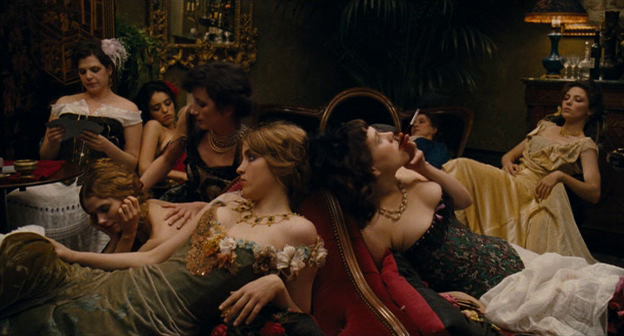
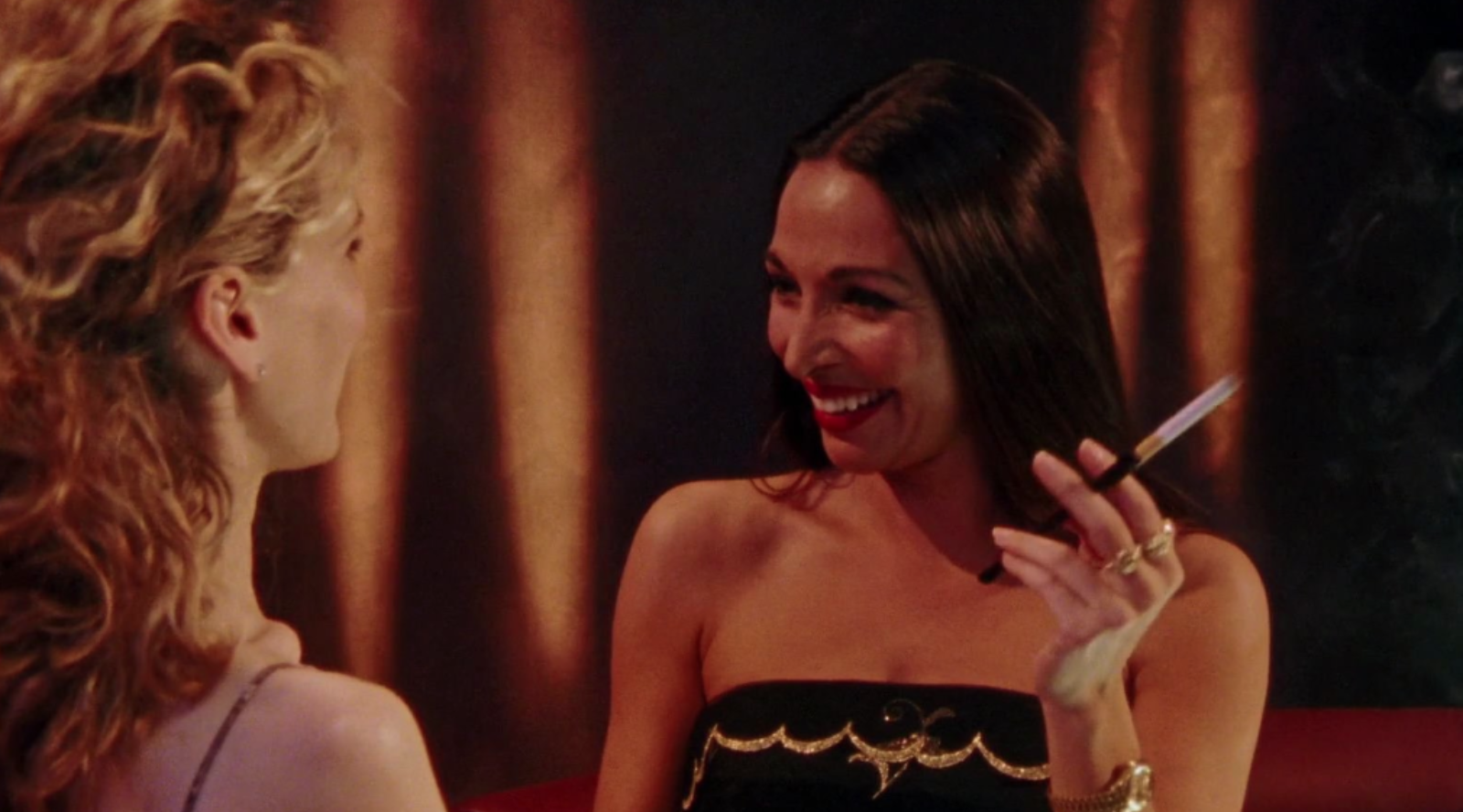
Does this movie glamorize the world of brothels and sex work? Absolutely—but it does an unquestionably damn good job of it: impeccable period costumes, a beautifully curated soundtrack containing the songs Nights in White Satin by The Moody Blues and Bad Girl by Lee Moses, and a carefully crafted script. Above all, the brothel workers are human and fully fleshed out characters, which I find incredibly important. The relationship between the workers is one of solidarity at all times: they hold vigil for Caca/Julie and comfort her as she succumbs to the effects of syphilis; they slowdance together to experience collective emotional catharsis. Even though the film is set in the early 1900s, the workers do many things that I have done with fellow workers in the 2010s and 2020s: laugh together, wait boredly for their shift to start, read tarot, show off our tattoos, and prioritize food.
Does this movie glamorize the world of brothels and sex work? Absolutely—but it does an unquestionably damn good job of it...
There are political aspects to this film, including Bonello’s comparison between France’s modern-day criminalization of brothels (since 1946) and allowance of street-based sex work. We see Marie-France writing desperately to an influential client when the brothel is threatened with closure, reminding him of his “great affection” for her house, and asking him to intervene on her behalf against the police. He, and all the other aristocratic clients with their wealth and influence, enjoy coming to the brothel but will not advocate for it to stay open if it means exposing themselves.
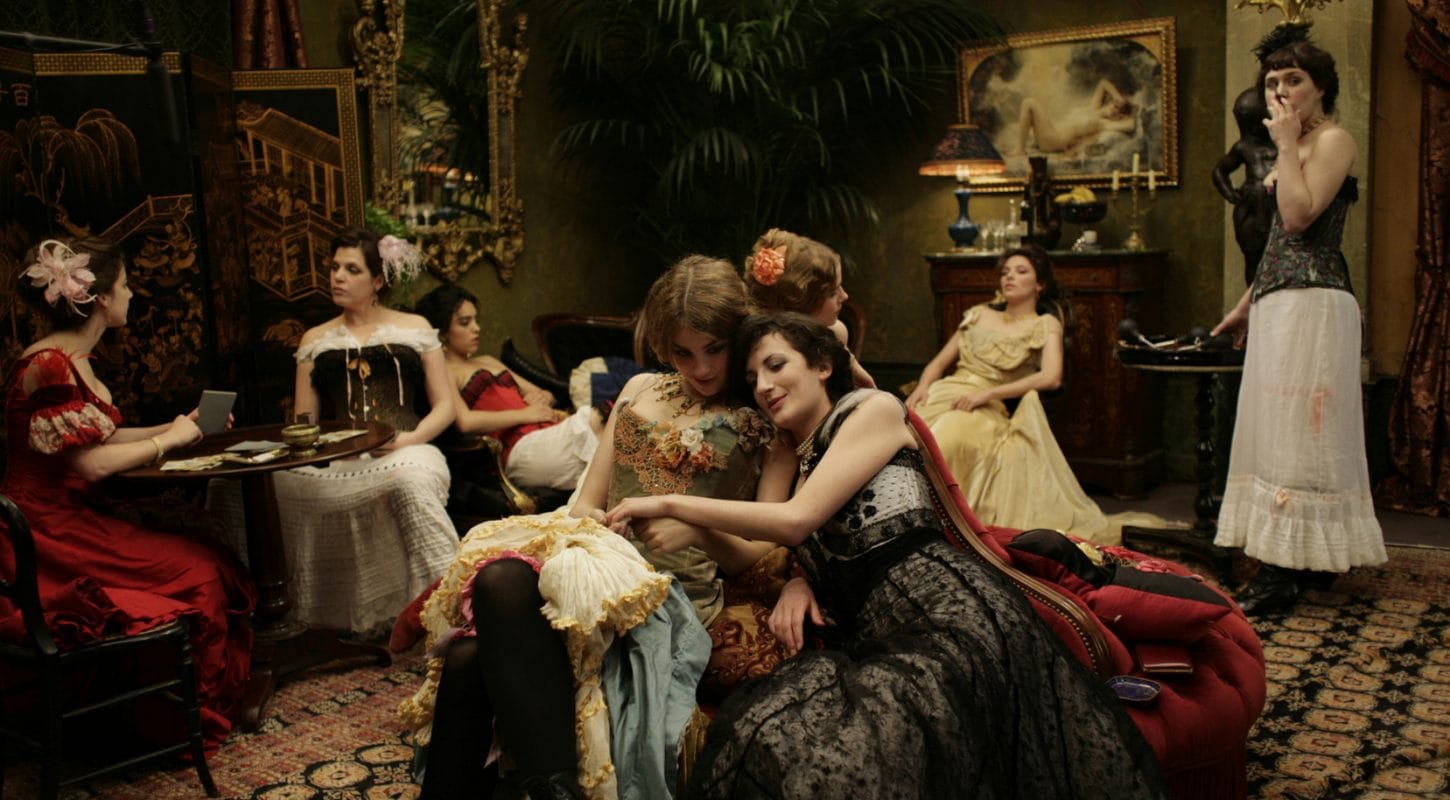
This is a movie of decadently beautiful visuals. I am Venusian to my core, and thus I find the elegant costumes and intricate set design to be a delicious feast for the senses. The film was apparently shot on a single continuous set, which is likely why I feel so immersed in the world of it while watching. We are introduced to each of the workers gently—many of them have nicknames they use in addition to their real names with clients: [translated into English from French] Fine Thigh/Clotilde, Caca/Julie (as she says with a wink, “Let’s just say, I have a specialty”), The Jewess/Madeleine, etc. Marie-France, the madame, is shown as stern, capable, and businesslike—her brothel is the business which sustains the life of her two young children, who also live in the house and are seen playing with the workers on their time off.
What I appreciate the most about L’Apollonide is the realistic depiction of sex work within that unique context of time and place. Normally when a civilian is making a movie about full-service sex work, they tend to focus on a very narrow conception of cisgender man to cisgender woman transactional penetrative sex. At L’Apollonide, clients have specific fetishes they wish to be fulfilled: we never see Caca (Julie) take a poop on her regular’s chest, but we hear about her specialty; Pauline, the fifteen year-old virgin who applies to work at the brothel simply because she wants to be a prostitute, is asked to pretend to be Japanese (eye roll) by the same artist who wants her to bathe in champagne for him when he takes her virginity; Lea, considered to be the most beautiful of the workers by clients besides Madeleine, aggressively voices her complaints to her fellow workers about the idiocy and the physical impacts of the “stupid fucking doll act” she is asked to do repeatedly by a client who wants her to pretend to be a living porcelain doll. When Marie-France is consulting with a client who has turned down the workers available at the brothel that night, she tells him quickly and without any hint of judgement, “I can send out for a boy if you like; it’s no problem.” The reality is that non-heteronormative desires from wealthy cishet men have always existed, even if they were only lived behind closed doors—as they often still are.
Bonello plays with surrealism and time jumps in the film’s plot, particularly around one of the film’s central events: an act of extreme violence against the sex worker Madeleine. In one scene, Madeleine is relating a dream she’s had to her regular/soon-to-be attacker. She tells him she dreamed they had sex, but he was wearing a mask; when he came inside her, she began to cry tears of his cum, and then he gave her an emerald ring. We see the dream acted out and we see the act of violence acted out; we are left somewhat unsure at moments of which is reality and which is not. But of course, what has been done to Madeleine is the reality, and the effect is that—at a time when reconstructive surgeries did not exist and ableism was normalized—she becomes the brothel’s laundress and is generally hidden from clients. Her new nickname becomes ‘The Woman Who Laughs’, because of her scars.

Yet, as time passes post-trauma and a new client asks to see her, she agrees, insisting to the other workers that the Madame did not force her, that she wanted to do it. It is a moment which speaks to her own desire to work, to be touched and caressed, and the agency she claimed when she accepted the booking.
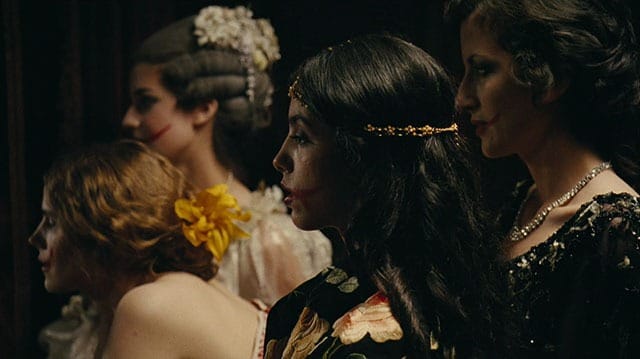
This is part of what keeps the violence against Madeleine from being a typical, heavy-handed story of tragedy about a sex worker; she has been victimized, but she refuses to be a victim and is not treated like one. She carries out her new household duties with dignity, and when the choice arises for her to work again, she takes it. The underlying feeling given to the viewer is that she does the work because she enjoys it: we see her do an outcall to attend a fetish party for a mixed-gender group of upper-class elites; when the brothel has a masquerade ball to celebrate its last night open, she dons a mask and rejoins her fellow workers with clients in the main parlor room, enjoying the freedom of her anonymity. The topic of violence is treated with the same period-specific realism as the other topics in the film: STIs, fear of pregnancy, race, drug use, and self-perception. Because the client who attacks Madeleine is a wealthy aristocrat, the idea of going to the police is not even brought up. The entrenched status quo is that aristocratic men are above the law.
The topic of violence is treated with the same period-specific realism as the other topics in the film...
There is a tension in the film for me because of the knowledge that some of the women have ‘debts,’—either personal debts being paid off in the brothel or debts they have come to L’Apollonide with from other brothels—and that these workers are effectively imprisoned by their inability to ever fully pay off the debt and buy their own freedom. When the brothel closes, Marie-France discusses with a hint of sadness that some of the women will go to other houses and have their debts transferred there.
Even small moments like when Marie-France discusses buying the debt of a Black worker she wants to join the brothel are reminders that cis white women were not the only ones working during this time period. I deeply appreciate the presence of Samira, an Algerian worker, in the brothel because it is a reminder of France’s colonial realities. It is Samira who reads the cards to divine the fortunes of her fellow workers during their free time (everyone asks about love!); it is Samira who is given a book on the pseudoscience of eugenics by a client, and who we see weeping because the book says that prostitutes all have tiny heads because they are criminals. Samira is the one who is fearful of the regular checkup from the visiting doctor because her periods have stopped and she is worried about being turned out of the brothel by Marie-France for being pregnant. Samira is the one who we see orchestrate the workers’ most delicious revenge against the client who attacked Madeleine. Finally, it is Samira who achieves the fantasy held by many of the workers, and is given an emerald by a client—a symbol that he will buy out her debt from the brothel and take her to live with him as his wife/official courtesan. As a sex worker of color, I was rooting for her and felt at peace seeing her find some version of a happy ending.
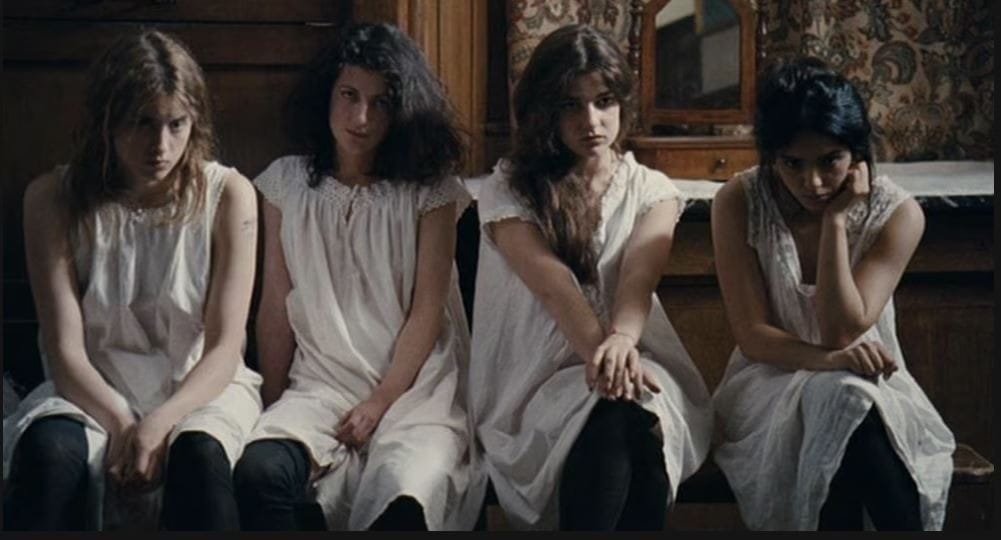
The reality of being a sex worker in the early 20th century is shown with direct honesty: being unable to go outside on your own due to moral codes; the only other labor alternatives to sex work available for those from the working class being backbreaking work as a laundress or seamstress; being passed syphilis by a wealthy client and passing away surrounded by your sex worker family. There is a stark difference between scenes shot in the upstairs apartments where the workers actually live and sleep, and the downstairs rooms where they see clients, which feels intentional—their regular world is soft, plain, almost monochromatic in pale whites, blues and browns, but when the clients see them, they and their surroundings appear as fantasies, almost like beautiful exotic birds in a garden.
The counterbalance to the tragedies depicted in the film—which I believe are shown as intentional dichotomies by Bonello—are having beautiful (albeit, shared) gorgeous gowns with expensive jewelry to wear for work, endless champagne, opium from an elegant pipe, visits from a live panther, being a famous artist's muse. The ‘the old days were better’ argument often used for just about everything isn’t so forcefully trotted out here, but it is clear that Bonello is making a comparison between the experience of working in legal brothels (regulated in France until being outlawed in 1946) and 2011-era street-based sex work in the movie’s final scene. We see Clotilde/Fine Thigh, seemingly transported to modern times, getting out of a client’s car on the streets of what looks like Paris’ Périphérique street prostitution scene. She walks alone, clearly stressed out, up the boulevard in an outfit that looks decidedly cheap compared to the opulent gowns she was wearing back in the 1900s.
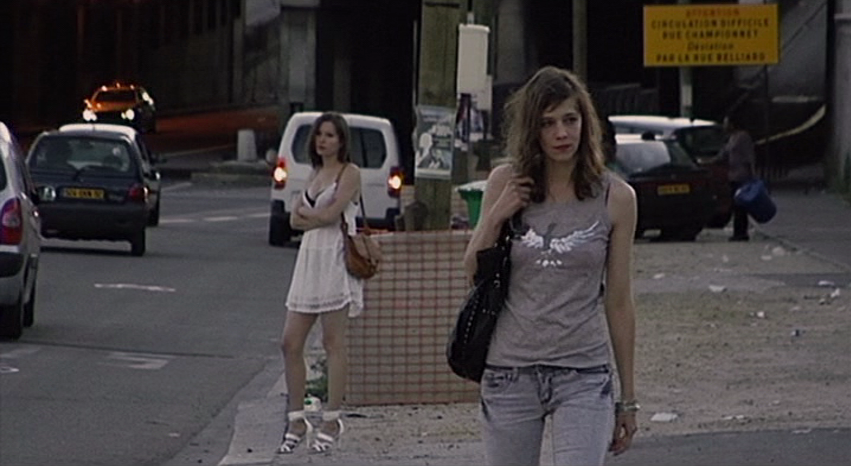
I do recommend this French film for those who adore beauty, aesthetics, and period pieces alongside subtle social commentary with a heavy dose of extravagance.
Certainly, there is an air of romanticism in how Bonello chooses to portray the heyday of turn-of-the-century elite sex work in L’Apollonide. I’d argue that this is because romanticism makes a good film—Bonello made a conscious choice not to show the type of brothel in Marseille that the Madame threatened to send Clotilde to if she kept smoking opium—one where she’d end up “with the clap”. I haven’t seen Bonello’s 2001 film Le Pornographe, about a retired former director of 1970’s pornography who comes out of retirement in the then-present day (it is on my list!), but it seems that Bonello has a thing for making comparisons about time periods of sex work. Obviously, the world of the brothel in L’Apollonide is for the most privileged of sex workers—anyone who’s seen or read Les Miserables has at least some taste of the hardships street-based sex workers faced in a time period roughly around that of which L’Apollonide is set. Perhaps Bonello is saying that the bygone world of (high-class) legal brothels at least offered some promise, comfort, and a sense of community for their workers when they were faced with issues like client violence or STIs – but it may be as shallow as him simply indicating how much better the aesthetics were in the richest of brothels back in that time compared to modern day Paris. He shows Clotilde alone, rather than working alongside community. He makes her seem very vulnerable, which can be a feeling all sex workers have, not just street-based sex workers. He also makes her seem vulnerable in an inherently classist way in his choice to juxtaposition Clotilde's modern day clothing with the extravagance of L’Apollonide's costumes (none of which the sex workers actually owned anyway). As a sex worker who at the time of writing this, has never worked in a brothel or on the street, I feel unqualified to assess his comparison beyond this point.
When I lived in Paris soon after the government passed the Nordic Model in 2016, I saw sex workers operating on the Boulevard Périphérique and out of parked vans in the same area where he puts Clotilde in the film’s ending. From my own colleagues in Paris, I know that post-Nordic Model, many street-based sex workers have been pushed deeper into working the Bois de Boulogne and experience higher violence in the forest. If brothels were to reopen in France, and they were as luxurious as L’Apollonide, that would be a wonderful thing; but would the same hierarchies of race, class, and gender continue to exclude some workers from non-sbsw spaces, preventing them from having a real choice between whether to work on the street or not? Perhaps that’s a good topic for Bonello’s next film.
Empress Mirage, also known online as @thepasteldomina, is a writer of smut and cultural commentary. She is a former fssw, bondage model, and stripper; she now creates online content as a findomme and living goddess. Her bylines appear in the Tryst.link blog, PetitMort magazine, PolyesterZine, and the Scarlett Letters Pride zine. She runs a popular Substack blog about sex work and magic, called ‘the sex/work & magic digest.’
Are you a sex worker with a story, opinion, news, or tips to share? We'd love to hear from you!
We started the tryst.link sex worker blog to help amplify those who aren't handed the mic and bring attention to the issues ya'll care about the most. Got a tale to tell? 👇☂️✨






)
