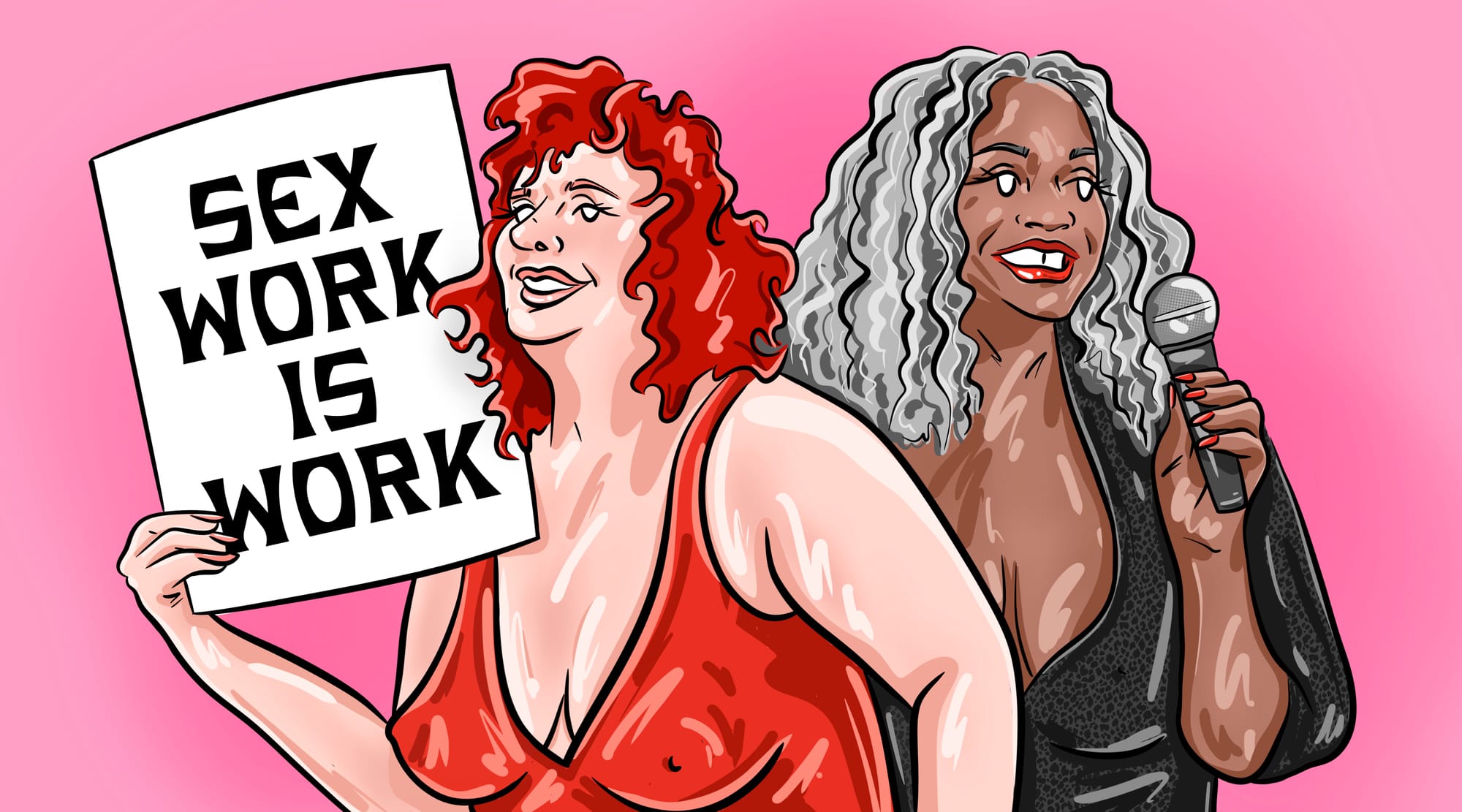
Dedicated to Carol Leigh and Sinnamon Love
How Definition Affects Our Community
‘Sex work’ is a term created in 1978 by the late, beloved old pro and activist Carol Leigh, aka The Scarlot Harlot. She first coined the term at an anti-pornography conference where they were using the term ‘Sex Use Industry’ to describe the porn industry. It was here that she first suggested that ‘Sex Work Industry’ would be a better term because it describes sex work as a job and allows for the separation of a person’s job from their personality, hobbies, life outside of work, and sense of self. [1] Leigh also advocated for sex workers rights from a labor standpoint, and from this point of view used her term ‘sex worker’ as an umbrella term for a range of various forms of erotic labor. She did this to unite sex workers and create a sense of solidarity and community across the sex industry. [2] Now when we say sex work, we can be referring to anything from and including escorting, pro-domming, cam modeling, performing in porn scenes, or stripping. These are just a few examples among many. I recently heard an old episode of “The Oldest Profession Podcast” where The Scarlot Harlot (Leigh) and thotscholar aka Moses were discussing language and the meaning of sex work. Leigh says,
“I think the definition of sex work is mutable. I mean basically, my favorite, I wanted it just to cover all erotic laborers. [...] In some contexts, if you’re writing a political document, it’s good to use it to mean all people performing erotic labor, I think, because then, [...] you can talk about all kinds of violations of sex worker rights. So that’s useful.” [3]
My favorite part of their conversation is how Leigh experienced such joy in learning from other sex workers and developing what these terms mean to us. I appreciate the listening that Leigh does and the constant reconsidering of what the term should mean even though she came up with it herself. Leigh has a flexibility in her thought process that I aspire to. I hope to continue to improve my own listening skills and to consider the reasons for using the term sex work in different ways. We are often requesting that the rest of society “listen to sex workers”, and I think we, as sex workers, should continue to work on listening to each other as well.
I know that some workers seek to narrow the definition of sex work for various reasons. Sometimes, it’s not including online workers in the umbrella of sex work. Other times some claim that performance-based work (like pornography) cannot be considered sex work. Sometimes it’s excluding cis men. Although the industry is and has been throughout history a way for women to make money independently, it’s important to remember that all genders have participated in sex work and continue to. A desire to narrow the definition of sex work may come from recognizing that all sex workers work in very different ways, and wanting to be in community specifically with people with similar experiences.
I know that some workers seek to narrow the definition of sex work for various reasons.
At this time, I do believe that letting sex work mean all erotic labor does more to serve our community than to limit the term to a smaller group of erotic laborers. I think it creates a stronger community where we can each support each other in the various struggles we are up against. I believe it makes it easier to talk about this work in places where some forms of work might be criminalized. It helps us form local or virtual support groups with our colleagues. It also helps us to be more unified and address the whorearchy (hierarchies among different erotic laborers) which sometimes shows up in our community due to our own internalised stigma. The concept behind using the term ‘sex work’ for any area of erotic labor helps to foster a thriving community among sex workers.
I recently heard about defining sex work based on how much risk is involved. I also consider this definition to be a mistake. First, it leaves us without a term for our future erotic labor, which will not be stigmatized or criminalized, and therefore carry less risk. Second, defining sex work by risk can reinforce victim narratives about our work that we try so hard to reframe in our fight for decriminalization.
Everyone assesses risk differently and chooses their own approach to sex work accordingly. If the risk of being all over the internet is too much for you, you may not choose porn, camming, or content creation. If the risk of seeing clients in real life is too much, you may not choose escorting, dancing, or working as a Domme at a dungeon.
As a term, I think ‘sex work’ not only speaks to our present struggles in the industry, but it is a term that I would feel comfortable using in my most idealized vision for our future, where we are neither victims nor criminals, and we are simply service providers of intimacy, connection, fantasy, kink, and fun. ‘Sex work’ also allows us to speak to our present moment and past in a way that humanizes our colleagues under the conditions of criminalization, partial criminalization, and the stigma we face. If our goal is rights as workers, we cannot use risk to define sex work, because it will stagnate our progress towards labor rights. That being said, risk can be used to assess privilege within the industry. When we have less risk, we have more privilege and should use our privilege to support other workers facing higher risk. And when we have more risk, we may need to lean on our community to keep ourselves safe.
I caution against narrowing the definition of sex work, because excluding some workers only makes our community smaller. We are stronger together when facing the obstacles of fighting for our rights and bodily autonomy, however and whenever that may show up in each of our various corners of the industry. Whether it’s the fight to decriminalize full-service sex work, the fight online sex workers have against age verification laws and project 2025 seeking to eradicate porn, or the banking discrimination that all of us sex workers face. Being a part of the sex work community means we need to support each other in each of these fights when they come up.
If our goal is rights as workers, we cannot use risk to define sex work, because it will stagnate our progress towards labor rights.
A sex worker and labor rights activist who I continue to be inspired by is Sinnamon Love. I feel so blessed to have met Sinnamon at a decriminalization advocacy day because Sinnamon is someone whose knowledge, experience, work, and solidarity with other workers keeps this community thriving. Sinnamon honors Carol Leigh’s legacy by promoting the idea that the voices of all sex workers matter.
It was my first advocacy day a few years back, and at that time I was just camming, so I felt I should let other workers with more experience have the floor when meeting with senators. When I said I was feeling that way, Sinnamon encouraged me to speak at the meeting, and to share my own story of being affected by the stigma in online work and the ways stigma could affect my housing situation. I’m not going to share the personal details here, but once I shared my story, it helped to show legislators how decriminalization relates to other issues, such as keeping people housed, and renter’s rights. It also showed that the stigma caused by criminalizing one form of sex work, creates stigma for all forms of sex work even though they might be legal. Sinnamon’s encouragement helped me to feel a part of the community, as well as strategically made our meeting with the senators a robust one, filled with varying powerful stories from different voices in the industry.
On a personal level, I also gained more courage after this meeting to advocate for sex workers in other communities I am a part of. Sinnamon’s encouragement made me a stronger advocate for sex worker rights. I really appreciate Sinnamon because she, like Carol Leigh, treats sex work as an umbrella term for many forms of erotic labor to be included in. Sometimes I see Sinnamon push back against whorearchical posts, reminding workers to remember the meaning of sex work, and to remember Carol Leigh’s intentions. I have to credit Sinnamon with providing the inspiration to start this essay with a focus on Carol Leigh and her intentions behind creating the term sex work. Remembering Carol Leigh’s work helps to gather my thoughts around the issues of whorearchy and better explain them in relation to labor. I really appreciate Sinnamon as a sex worker and activist who is truly doing work that makes our community a better place to be. She can definitely inspire and guide us toward a community without hierarchies and stigma. Like Sinnamon, we should all be honoring Carol Leigh’s legacy by listening to and uplifting the stories of all sex workers, and remembering that our community is stronger together.
Destigamatizing Our Community From The Inside First: Addressing The Whorearchy
Our community, just like any other, requires work from its members. It requires the obvious work of physically (or virtually) showing up for each other at regular intervals or as needed. It also requires the personal work of addressing the negative beliefs around sexuality or the labor of sexual services that we may have grown up hearing in our families, churches, communities, or simply in mainstream society. Our experience working in the sex industry can help us to reconceptualise some of those negative beliefs; however, it requires some extra attention to break down beliefs about another area of the industry that we ourselves have never worked in. For example, as someone who has never worked in a strip club, I can only learn from others who have worked there.
Whorearchy occurs when a sex worker judges or holds negative beliefs or shares stigmatized viewpoints about another area of labor under the sex work umbrella. It can occur, of course, from more privileged workers toward those with less privilege or working under more precarious conditions. But it can also occur laterally across the different areas of labor in the sex industry.
As someone who engages in various forms of sex work across the industry, the whorearchy really frustrates me. These are some ways I have seen whorearchy show up in our community this past year, for consideration. I have seen escorts judging the work of online independent porn content creators when they go viral. My frustration with this is that comments from other sex workers are sometimes the exact same comments that SWERFs (sex work exclusionary radical feminists) are making. For example, comments that judge a performer based on how many scene partners are in a given shoot. It almost hurts me more to see this comment from a fellow sex worker than from a SWERF, who is assumed to have no experience in the sex industry. The comments are expected from SWERFs, but for that same comment to come from the voices in our own community really hurts.
Our community, just like any other, requires work from its members.
Whorearchy can also occur from porn performers towards escorts and other full service sex workers. Sometimes, porn performers or other online workers distance themselves from full service sex work by refusing to self identify as a sex worker. We also sometimes see this from celebrities who either take on sex work as side project, or have previous experience in sex work. Lily Allen used OnlyFans to sell feet pictures, distancing herself from the sex industry by making jokes around the content she was making and blocking sex workers who asked her how she was supporting the industry that she was a part of. [5] Cardi B acknowledges her experience as a stripper and isn’t shy about it, but in several songs makes sure to distance herself from full service sex work by stating, “I said ‘dance’ not ‘fuck’ don’t get it confused” [6] and “Hos be prostitutes” [7]. I acknowledge that there is risk in supporting full service sex workers. But I also believe when people have enough resources that taking the risk won’t affect their means of survival they should take that risk and be in solidarity with full service sex workers. Supporting full service sex workers and advocating for decriminalization helps those in other forms of sex work as well. It says to lawmakers that their constituents don’t buy into purity culture or abide by their power to make laws that govern people’s bodies.
The whorearchy shows up at times when workers compare ‘sexually transmitted infection’ (STI) prevention methods in a judgmental way. Some in-person workers who are directly interacting with clients may choose to use protection for all activities. When porn performers shoot a scene, they test for a full panel of STIs to be shared with their scene partner. Other in-person street-based sex workers may not have the privilege of carrying condoms. In places where full service sex work is criminalized, condoms have been used as so called ‘evidence’ by police. Some escorts do not have the financial privilege to say no to requests from clients to not wear protection. Comparing methods of practicing safe sex, or even judging those who may have to take more risks for their business, is not solidarity. As we learn and grow in our business experience, we are gaining sexual education that may have been withheld from us by family, schools or government. Through our work, we gain new information, ways of protecting ourselves, and can pass this on to our connections in the civilian world, who also probably did not receive adequate sexual education. We sex workers are the best in the world poised to combat the stigma of STIs. We have to act like it.
Rate shaming is another way that we allow whorearchy to continue in our community. While talking about money together is a great way to encourage financial literacy, we must acknowledge that rate shaming still exists. Rate shaming is an obvious form of perpetuating hierarchy within our community. People have different needs and ways of working. People have different levels of privilege. All of these things affect what rate one can charge. I know some of my trans colleagues are not able to ask for deposits. I know that Black, Indigenous and people of color (BIPOC) sex workers face more pushback from clients for higher rates than their white colleagues. Privilege also depends on the worker’s access to other work. Having multiple hustles will allow one to charge more. Privilege also is affected by disability. Taking long periods of time off of work to heal or manage pain affects what one is able to charge once they’re ready to start work again. Overall, privilege directly impacts rates in the sense that those who have money already saved can charge a higher rate because their savings allows them to wait for the client who will pay that. Compared to a sex worker who may not have savings, means they have less economic privilege and therefore lower their rates in order to book with a client sooner and address their immediate needs.
Our rates do not equal our value. All of our value as human beings working in the sex industry is immeasurable. We bring people joy at a variety of price points. There is nothing wrong with that.
Our rates do not equal our value. All of our value as human beings working in the sex industry is immeasurable.
We need to let our rage be directed toward lawmakers, toward advocating for decriminalization, better banking and against age verification laws, rather than toward other sex workers. The stigma of sex work and even sexual pleasure is alive and well from many places outside of our industry. We must do the work of destigmatizing our own minds and making sure our community is a place of safety and solidarity for all sex workers. We can be inspired by the work of industry veteran and advocate, Sinnamon Love. Unifying across the sex work industry makes us stronger advocates for all erotic labor causes. In the same way that we would like to be supported by other labor organizations in other industries to create strength among all workers of the world, we must start this process by supporting each other in our own industry. By doing this, we can honor the life of our beloved elder and sex worker, Carol Leigh. I hope we continue to contemplate her reasons for creating the term sex work and continue building towards community and solidarity in her legacy.
Sources:
[4] “About The Adult Industry” Free Speech Coalition.
[6] Cardi B. “Get Up 10” Invasion of Privacy. 2018.
[7] Cardi B. “Better Than You” Am I The Drama? 2025.
For more info and perspectives on the whorearchy, take a look at Whorearchy 101 and Finding Your Perfect Escort is all About Saying ‘No’ to the Whorearchy.
Are you a sex worker with a story, opinion, news, or tips to share? We'd love to hear from you!
We started the tryst.link sex worker blog to help amplify those who aren't handed the mic and bring attention to the issues ya'll care about the most. Got a tale to tell? 👇☂️✨